


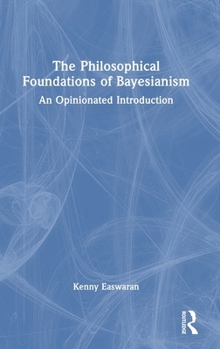
The Philosophical Foundations of Bayesianism: An Opinionated Introduction

Bayesianism is the view that rational degrees of belief should follow probability theory. In this book, philosopher Kenny Easwaran defends Bayesianism as an effective normative framework when applied to all "doxastic subjects" humans, animals, artificial intelligences, groups, and even hypothetical aliens or angels.
The book addresses major challenges: concerns about numerical precision and computational tractability, problems with infinitesimals and regularity, difficulties with act-state dependence, and debates over evidence. Easwaran employs measurement theory to show probabilistic representation is analogous to representing temperature - different scales (Fahrenheit/Celsius, probability/odds) can represent the same underlying non-numerical reality.
Later chapters examine how beliefs should update through conditionalization, while distinguishing different sources of rational norms. Easwaran defends a notably permissive view: any probability function is internally rational, as reason alone cannot dictate privileged priors. However, "ecological rationality" explains why certain belief systems perform better in specific environments, acknowledging both Bayesianism's abstract permissiveness and practical constraints making certain credal states more successful.
Related Subjects
PhilosophyCustomer Reviews
ThriftBooks® and the ThriftBooks® logo are registered trademarks of Thrift Books Global, LLC
