


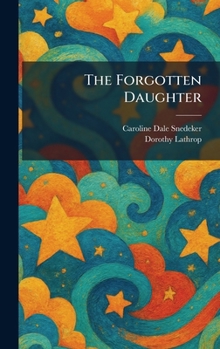
The Forgotten Daughter

Select Format
Select Condition 
Book Overview
"The Forgotten Daughter" is a compelling historical novel set against the backdrop of the Roman Republic. The story follows Chloe, a young girl born of a high-ranking Roman father and a Greek mother, who finds herself living as a slave on her father's own villa after being abandoned in her infancy. Growing up in the harsh environment of a Roman country estate, Chloe must navigate the complexities of her dual heritage and the rigid social hierarchies of the ancient world.
The narrative captures the vivid contrast between the intellectual beauty of Greek culture and the stern, often brutal reality of Roman law and custom. As Chloe matures, she encounters the legendary Gracchi brothers, whose political movements for reform provide a dramatic historical setting for her own journey toward freedom and identity. The work is renowned for its historical accuracy and its sensitive portrayal of a young woman's resilience.
This classic work of historical fiction explores themes of justice, family, and the enduring power of the human spirit. "The Forgotten Daughter" remains a significant contribution to literature for young readers, offering an immersive look into the life and times of ancient Italy through the eyes of a character caught between two worlds.
This work has been selected by scholars as being culturally important, and is part of the knowledge base of civilization as we know it. This work was reproduced from the original artifact, and remains as true to the original work as possible. Therefore, you may see the original copyright references, library stamps (as most of these works have been housed in our most important libraries around the world), and other notations in the work.
This work is in the public domain in the United States of America, and possibly other nations. Within the United States, you may freely copy and distribute this work, as no entity (individual or corporate) has a copyright on the body of the work.
As a reproduction of a historical artifact, this work may contain missing or blurred pages, poor pictures, errant marks, etc. Scholars believe, and we concur, that this work is important enough to be preserved, reproduced, and made generally available to the public. We appreciate your support of the preservation process, and thank you for being an important part of keeping this knowledge alive and relevant.
Customer Reviews
ThriftBooks ® and the ThriftBooks ® logo are registered trademarks of Thrift Books Global, LLC
