


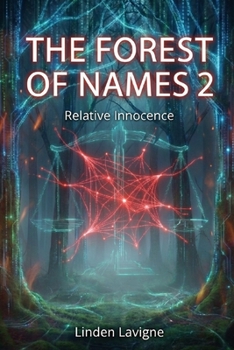
The Forest of Names 2: Relative Innocence
No Customer Reviews

In a world where every connection is mapped, justice is no longer a judgment of intent. It is a calculation of debt. The Human Kinship Archive maps every bloodline, marriage, and recorded connection, a glowing digital forest that underpins identity, law, and social trust. To be legible is to belong. To be unlinked is to be suspect. After a devastating industrial catastrophe with no clear culprit, the legal system mutates into something unrecognizable. The state invokes a new doctrine: Relational Liability Assessment. Powered by the Archive, guilt no longer stops at the individual. It spreads through marriage, employment, inheritance, and proximity. Responsibility isn't assigned by what you did, but by what you benefited from. Adrian Keller is a public defender for the "peripheral respondents", ordinary people who committed no crime, yet face ruin because they are mathematically linked to the disaster's fallout. As courts replace human testimony with topology, Adrian watches a chilling new moral language take hold: relative innocence. In this new order, some are more innocent than others, but no one is truly untouched. As the kinship graph expands to claim every human soul, anonymity becomes suspicion, and the right to be a stranger is treated as evasion. Relative Innocence is a cold, psychologically intimate dystopian thriller about justice without intent and the quiet terror of being fully known. The second installment in The Forest of Names series, it explores the existential horror of a society that has traded the mystery of the individual for the precision of the node.
Format:Paperback
Language:English
ISBN:B0GMXV5GTC
ISBN13:9798247842132
Release Date:February 2026
Publisher:Independently Published
Length:150 Pages
Weight:0.46 lbs.
Dimensions:0.3" x 6.0" x 9.0"
Customer Reviews
0 rating
Copyright © 2026 Thriftbooks.com
Terms of Use | Privacy Policy | Do Not Sell/Share My Personal Information | Cookie Policy | Cookie Preferences | Accessibility Statement
ThriftBooks ® and the ThriftBooks ® logo are registered trademarks of Thrift Books Global, LLC
ThriftBooks ® and the ThriftBooks ® logo are registered trademarks of Thrift Books Global, LLC
