


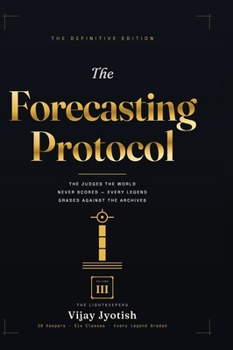
The Forecasting Protocol - Volume III: The Lightkeepers

On the night of September 26, 1983, a Soviet lieutenant colonel watched his early-warning system report five American missiles in flight - and decided, in minutes, that the machine was wrong. Stanislav Petrov was right. He was also, in every way that matters, unweighed: no record lent his judgment authority that night, and no ledger banked it afterward. Billions for the sensors. Nothing for the judge.
The Lightkeepers is a history of that missing ledger - told through the judges the world was lucky to have and too late to measure. The reviewer who stopped thalidomide at the American border. The codebreaker whose read won Midway and whose medal arrived posthumously. The journalist who named Bhopal's catastrophe in print, twice, two years early. The Cuban observatory whose hurricane telegram was banned from the wires eleven days before Galveston drowned. The analyst who hand-delivered the Madoff fraud to the regulator five times in nine years. The security director whose mocked stairwell drills walked 2,680 people out of the South Tower. Forty years of exercises, memos, and warnings that were filed - and the institutions, staffed with capable people and possessing no instrument for pricing a human judgment, that filed them.
This is not a gallery of heroes. It is a graded gallery. Every story is verified against primary records - official investigations, court rulings, sworn testimony, contemporaneous print - and told at its documented weight. Where the popular legend outruns the archive, the correction is delivered in the body of the text: the false medal, the invented telegram, the scene from a novel laundered into history, the celebrated near-miss that rests on a single uncorroborated account. Even the most beloved stories - the submarine officer's veto, the spy's named invasion date - are held in a back room, labeled at the door. And the book grades the other side too: the counterweight chapters tell the stories where heeding the warning was the error, from the 1976 swine flu campaign to the 2002 Iraq weapons estimate - because a scoreboard that only remembers one column is not a scoreboard.
The final chapters turn from history to remedy: the calibration ledger - judgment sealed before the outcome, graded after, misses kept at full weight - demonstrated on a live public record, and proposed as ordinary civic infrastructure for the warning desks, the exercises, the walk-ins, and the machine judges now taking their seats beside the human ones.
Volume III of The Forecasting Protocol. Volume I gives the method; Volume II proves it live; this volume shows what a century without it cost. Each volume stands alone.
The book maintains a public errata ledger, correcting itself under the same rules it applies to everyone else.
Customer Reviews
ThriftBooks ® and the ThriftBooks ® logo are registered trademarks of Thrift Books Global, LLC
