


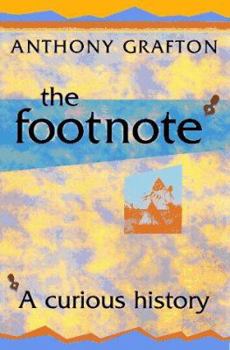
The Footnote: A Curious History


Select Format
Select Condition 
Book Overview
The footnote emerges in this book as a singular resource which reveals much about the evolution of modern scholarship and the progress of knowledge in written form. Grafton treats the development of the footnote - a form of proof normally supplied by historians in support of their assertions - as writers on science treat the development of laboratory equipment, statistical arguments and reports on experiments as a complex history. The book begins in the Berlin of the 19th century and explores the work of historian, Leopold von Ranke, who is often credited with inventing documentary history in its modern form. It then looks back to antiquity and forward to the 20th century, offering a theory of the true origins and gradual development of the footnote."
Format:Hardcover
Language:English
ISBN:0674902157
ISBN13:9780674902152
Release Date:December 1997
Publisher:Harvard University Press
Length:256 Pages
Weight:1.00 lbs.
Dimensions:8.8" x 0.8" x 5.8"
Customer Reviews
4 ratings
witty, whimsical tour of the methodsof historical learning
Published by Thriftbooks.com User , 20 years ago
The history, use and meaning of the footnote is a rather unlikely subject for a book, however, Grafton uses it to focus on the practice of history and the flesh-and-blood jealousies, mistakes and falsehoods which lie behind even the driest of academic pursuits. One caveat, which struck me at the start, is that surely footnotes would not have evolved solely form historical research, surely they would have surfaced in more useful contemporary documents, perhaps to do with legal or diplomatic professions. That apart, Grafton takes the evolution of the footnote in historical scholarship as the evolution of `scientific' methodology in historical research. On the surface Grafton states that the `the text persuades, the notes prove'. Originally history was story telling by people who claimed to be present, and/or participants, in great events. As scholarship evolved, the fact that participants might have different motivations, points-of-view and/or explicit biases became increasingly apparent. "Ambassadors' reports - a great source of archival works - report on deliberations to which they did not have direct access and the intentions of monarchs who did not speak frankly". Therefore scholars began to quote their sources by use of footnotes to the main text. Within this context, Grafton illustrates the distance some scholars will go to, in terms of selective quotation of some sources, the suppression of others and it is this which enlivens a topic which otherwise might have been deathly-dull. He acknowledges, with admiration, that some historians use footnotes to allow that there exist contrary interpretations of the thesis they are pursuing. However his work in the field allows him to allow him to add venom e.g. ` but often they (historians) quietly set the subtle, but deadly cf. (compare) in the footnote. This indicates, at least to the expert reader, both that an alternative view appears in the cited work and that it is wrong'. Grafton has worked in many European languages and this allows him to humorously include and compare the many differing ways that footnotes can convey bile - " The English do so with a characteristically sly adverbial construction `oddly overestimate'. Germans use the direct `ganz abwegig' (totally off-track); the French, a colder, but less blatant `discutable'". The book traces the evolution of the `scientific' recording and interpretation of texts to convey historical scholarship through the work of historians of three centuries, and it is though this that Grafton exhibits great learning and humanity. The foibles, ambitions and disputes are clearly acknowledged as is their passion for their work. Grafton has clear sympathy for both. He is more grudging in acknowledging the contribution of philosophy - specially the work of Descartes and Voltaire - in the development of the uneasy concoction of art and science which is modern history. This is a magnificent description of an exchange between Liebnitz and Bayle
Review of Anthony Grafton's The Footnote*: a curious history
Published by Thriftbooks.com User , 25 years ago
Review of Anthony Grafton's The Footnote*: a curious history (Harvard University Press, Cambridge, Mass.) 1997Although the history of the footnote may seem like a dull topic for discussion, it yields many interesting insights on how historians have practiced their trade. What makes Grafton's account so strong is not only his wit and metaphorical humor, which is often lacking from other academic historians' work, but his detailed and thorough treatment of this seemingly forgotten tool of the intellectual historian. Grafton conveys, through reverse chronological order, the origins of the footnote, and in the process manages to explain its use and purpose by those such as Gibbon and Ranke. Perhaps most interesting is Grafton's own use of the footnote. Through the mastery of four languages, he establishes his authority and even manages to denigrate others with the deadly "Cf." It is not surprising that his pages suffer from the "swelling feet of claylike annotation" that Ranke so eagerly wanted to avoid. Grafton's narrative of the footnote is a useful addition to the reading of any academic historian or student of history.
Review of Anthony Grafton's The Footnote*: a curious history
Published by Thriftbooks.com User , 25 years ago
Although the history of the footnote may seem like a dull topic for discussion, it yields many interesting insights on how historians have practiced their trade. What makes Grafton's account so strong is not only his wit and metaphorical humor, which is often lacking from other academic historians' work, but his detailed and thorough treatment of this seemingly forgotten tool of the intellectual historian. Grafton manages to convey, through reverse chronological order, the origins of the footnote, and in the process manages to explain its use and purpose by those such as Gibbon and Ranke. Perhaps most interesting is Grafton's own use of the footnote. Thorough the mastery of four languages he establishes his authority and even manages to denigrate others with the deadly "Cf." It is not surprising that his pages suffer from the "swelling feet of claylike annotation" that Ranke so eagerly wanted to avoid. Grafton's narrative of the footnote is a useful addition to the reading of any academic historian or student of history.
A superb study of the hypertextuality of historical prose
Published by Thriftbooks.com User , 27 years ago
A masterful, scholarly, and surprisingly lively account of the development of the modern footnote, this slender volume offers fascinating insights into the nonlinearity of the page. Highly recommended.
Copyright © 2026 Thriftbooks.com
Terms of Use | Privacy Policy | Do Not Sell/Share My Personal Information | Cookie Policy | Cookie Preferences | Accessibility Statement
ThriftBooks ® and the ThriftBooks ® logo are registered trademarks of Thrift Books Global, LLC
ThriftBooks ® and the ThriftBooks ® logo are registered trademarks of Thrift Books Global, LLC
