


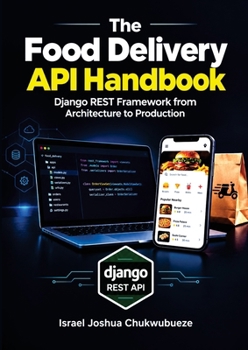
The Food Delivery API Handbook: Django REST Framework from Architecture to Production

THE FOOD DELIVERY API HANDBOOK
Django REST Framework from Architecture to Production
Building a food delivery platform is much more than creating restaurant and order endpoints. A production-ready system must handle authentication, restaurants, menus, carts, payments, riders, delivery tracking, notifications, real-time updates, security, testing, deployment, and many business rules that appear as the platform grows.
The Food Delivery API Handbook: Django REST Framework from Architecture to Production gives developers a practical guide to designing and building a scalable food delivery backend with Django, Django REST Framework, PostgreSQL, Redis, Celery, Django Channels, GeoDjango, and modern API development practices.
Written by Israel Joshua Chukwubueze, formerly known as Christopher Ekene Okade, an author, instructor, mentor, and technology professional with over 16 years of experience in design and software development, this book is based on a passion for writing, teaching, building, and sharing practical technology knowledge.
Rather than focusing only on isolated code examples, the book connects the major parts of a food delivery system so you can understand how they work together as a complete backend architecture.
Inside This Book, You Will Learn How To:
- Plan the Architecture
Design a food delivery backend using a modular approach and make informed decisions about synchronous and asynchronous processing.
- Design a Reliable Database
Model customers, restaurants, menu items, carts, orders, riders, payments, reviews, and other core entities using PostgreSQL.
- Build Secure Authentication
Implement custom users, role-based access, JWT authentication, token management, verification, password recovery, and permissions.
- Create Restaurant and Menu APIs
Handle restaurant onboarding, business hours, categories, menu items, variants, add-ons, pricing, availability, and menu management.
- Build the Complete Order Flow
Connect carts, checkout, pricing, coupons, order creation, cancellation, order status changes, and customer instructions.
- Add Real-Time Features
Use Django Channels and WebSockets for live order status updates between customers, restaurants, and riders.
- Manage Delivery Operations
Build rider assignment, live location tracking, distance calculations, ETA logic, geofencing, and delivery history.
- Integrate Payments and Payouts
Work with payment concepts involving Stripe, Paystack, Flutterwave, refunds, webhooks, commissions, restaurant payouts, and rider earnings.
- Automate Background Processing
Use Celery, Redis, and Celery Beat for notifications, scheduled jobs, retries, and other background operations.
- Improve API Quality and Security
Add OpenAPI documentation, API versioning, throttling, testing, monitoring, secure configuration, and protection against common API vulnerabilities.
- Prepare for Production
Containerize the application with Docker, plan CI/CD, scale backend services, configure monitoring, and establish long-term maintenance practices.
Whether you are building a food delivery startup, learning Django REST Framework, developing a marketplace backend, or strengthening your backend engineering skills, this book provides a structured path from domain planning and architecture to production deployment.
Build the API. Understand the architecture. Connect the systems. Prepare the backend for real-world growth.
Customer Reviews
ThriftBooks ® and the ThriftBooks ® logo are registered trademarks of Thrift Books Global, LLC
