


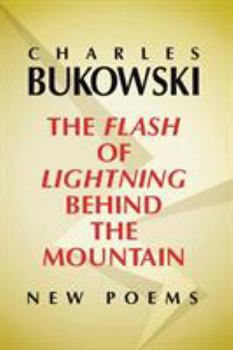
The Flash of Lightning Behind the Mountain: New Poems

Select Format
Select Condition 
Book Overview
The second of five new books of unpublished poems from the late, great, Charles Bukowski, America's most imitated and influential poet -- 143 never-before-seen works of gritty, amusing, and inspiring verse.
Format:Paperback
Language:English
ISBN:0060577029
ISBN13:9780060577025
Release Date:January 2005
Publisher:Ecco Press
Length:320 Pages
Weight:0.91 lbs.
Dimensions:0.8" x 6.4" x 9.0"
Customer Reviews
5 ratings
one of buk's best
Published by Thriftbooks.com User , 20 years ago
if you're here i'm guessing you're familiar with Charles Bukowski. These posthumous collections are supposed to span a wide range of Bukowski's career. I've found them to be more poignant, and "The Flash of Lightning Behind the Mountain" has been my favorite so far. You'll find the ususal introspective work and and observations from a lifetime put forward with great honesty. Here they are arranged in a manner which work as a whole. A credit to John Martin who managed all this art.
The best read I've had since the Sea Wolf
Published by Thriftbooks.com User , 20 years ago
Deeply philsophical, intelligent, and, at moments, humorous. Bukowski is genius. I personally love the compilations of poems rather than a book. I can read for short periods, between duties, or go for hours because of the raw depth he has compiled into his life and words.
Too Many Dumb People Crawl The Earth
Published by Thriftbooks.com User , 21 years ago
Quoting partially out of B as an Bull****from page 117. Be able to dislike poets and poetry Be able to understand that the rich can be poor in spirit Be able to understand that the poor live better than the rich If you posses any intelligence you should be able to define the words POOR and RICH Bukowski was a contradiction, which made him even more interesting, so he chose to kill himself with alcohol and cigarettes that's his business. That does not take away his talent, it may have something to as to why he contradicted himself so much, but I'm not a shrink and even if I was that wouldn't mean anything. I loathed free verse in college while I was learning to write sonnets, but once I was introduced to Bukowski, it all changed. He was raw, outspoken, and politically incorrect. He was short and quick to the point and made you think and question many things. Isn't that what art is supposed to do? You can pick up this book and read any little poem such as "poop", "the road to hell", or "pretenders" just to name a few and your outlook on things will change. It mesmerizes that a dead man continues to enlighten people. I don't agree that this book is exactly his mellowest, but one of his best works.
Bukowski at his best
Published by Thriftbooks.com User , 22 years ago
There are three phases of Bukowski's poetry. (1) The hard-drinking, experimental 1960s and 1970s. In that period, he was putting out small chapbooks. His poems were short stories, but they felt a bit like traditional poetry. Bukowski tried some creative ways of stringing lines together back then, too. (2) The 1980s, when he was married and settled, spending time reflecting on his life. This is the best period, when Black Sparrow put out fat volumes of poetry and Bukowski had really found his 'voice.' (3) The post-death period, starting in the mid-1990s, when the back log of unpublished poems were released.This book is part of that third phase. By this time, Bukowski knows exactly what he does best. Most of the experimentation is gone. This volume of one of the best of the third phase, right up there with The Night Torn Mad By Footsteps. Bukowski writes about his childhood, drinking, visiting the hospital for leukemia, the track, classical music, his father, relaxing with his wife, and growing old in Los Angeles. He even squeezes in two political poems. Every poem is good. Some are great. If you made a 'greatest hits' collection of his post-death poetry, at least a third of this book would be in it.If you haven't tried Bukowski's poetry before, start with this book. If you're a fan, you'll be pleased with this new one. Previous 'third phase' books had some problems ("Sifting Through the Madness" was a disappointment), but this one shines. Bukowski is at his most reflective, with real control of his talent.
Mellower Buk
Published by Thriftbooks.com User , 22 years ago
Charles Bukowski may prove to be the most prolific dead writer of all time. Every year seems to see another few hundred new poems published. I've no idea how many more there may be, but I'll probably buy them all. This collection is obviously from the mind of a man contemplating the past and not expecting a lot of future. But, Bukowski started referring to himself as old at about age 50, which may have been justified by the sort of life he had led to that point. The pieces in this book are on a par with what's gone before and well worth the attention of Bukowski fans.
Copyright © 2026 Thriftbooks.com
Terms of Use | Privacy Policy | Do Not Sell/Share My Personal Information | Cookie Notice | Cookie Preferences | Accessibility Statement
ThriftBooks ® and the ThriftBooks ® logo are registered trademarks of Thrift Books Global, LLC
ThriftBooks ® and the ThriftBooks ® logo are registered trademarks of Thrift Books Global, LLC
