


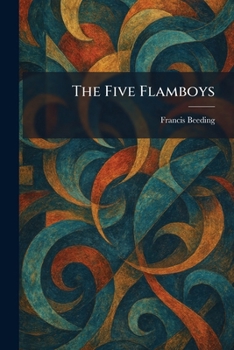
The Five Flamboys

Select Format
Select Condition 
Book Overview
"The Five Flamboys" is a high-stakes espionage thriller that transports readers to the volatile political landscape of post-World War I Europe. When a mysterious coded message involving five "flamboys" is discovered, British intelligence officer Colonel Granby is thrust into a web of international conspiracy. The narrative follows Granby as he navigates the diplomatic corridors of Geneva and the rugged terrain of the Danube to thwart a plot that threatens the stability of the Balkans and the life of a young king.
Francis Beeding delivers a masterclass in suspense, blending intricate detective work with fast-paced action. As Granby faces off against ruthless adversaries in a race against time, "The Five Flamboys" explores themes of loyalty, political maneuvering, and the enduring shadow of the Great War. This classic work of early 20th-century fiction is an essential read for fans of vintage spy novels and atmospheric mysteries that capture the tension of the interwar era. Its sophisticated blend of geopolitical stakes and character-driven drama marks it as a standout entry in the evolution of the modern spy novel.
This work has been selected by scholars as being culturally important, and is part of the knowledge base of civilization as we know it. This work was reproduced from the original artifact, and remains as true to the original work as possible. Therefore, you may see the original copyright references, library stamps (as most of these works have been housed in our most important libraries around the world), and other notations in the work.
This work is in the public domain in the United States of America, and possibly other nations. Within the United States, you may freely copy and distribute this work, as no entity (individual or corporate) has a copyright on the body of the work.
As a reproduction of a historical artifact, this work may contain missing or blurred pages, poor pictures, errant marks, etc. Scholars believe, and we concur, that this work is important enough to be preserved, reproduced, and made generally available to the public. We appreciate your support of the preservation process, and thank you for being an important part of keeping this knowledge alive and relevant.
Customer Reviews
ThriftBooks ® and the ThriftBooks ® logo are registered trademarks of Thrift Books Global, LLC
