


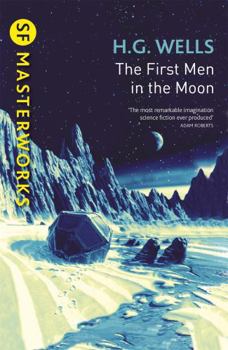


Book Overview
'As we saw it first it was the wildest and most desolate of scenes. We were in an enormous amphitheatre, a vast circular plain, the floor of the giant crater. Its cliff-like wall closed us in on every side '
Thanks to the discovery of an anti-gravity metal, Cavorite, two Victorian Englishman decide to tackle the most prestigious goal - space travel. They construct a sphere that will ultimately take them to the moon. On landing, they encounter what seems like an utterly barren landscape but they soon find signs that the planet was once very much alive. Then they hear curious hammering sounds from beneath the surface, and come face to face with the Selenites, a race of insect-like aliens living in a rigidly organised hive society.
Customer Reviews
Professor Cavor meets the Big Kahuna, oops, Grand Lunar.
A fun read, and a fascinating sci-fi book
H.G. Wells at his best
Maybe my favorite sci-fi book of all
Excellent annotation for excellent science fiction
Great development of characters
The First Men in the Moon Mentions in Our Blog
A hundred years ago, novelist H.G. Wells predicted that science would be "king of the world." Titanic's Jack Dawson may take issue with that claim, but he’d have a tough time disputing the compelling influence Wells had on politics, society, and the future that extended far beyond the literary realm. Considering Wells is one the founding fathers of sci-fi (along with Jules Verne and Edgar Rice Burroughs) and the author of The Time Machine, The Invisible man, The Island of Dr. Moreau, and The War of the Worlds, that's saying something.
ThriftBooks ® and the ThriftBooks ® logo are registered trademarks of Thrift Books Global, LLC
