


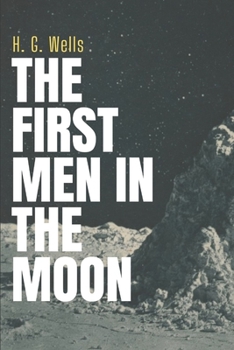
The First Men in the Moon

H.G. Wells, in full Herbert George Wells, (born September 21, 1866, Bromley, Kent, England-died August 13, 1946, London), English novelist, journalist, sociologist, and historian best known for such science fiction novels as The Time Machine and The War of the Worlds and such comic novels as Tono-Bungay and The History of Mr. Polly. Wells was the son of domestic servants turned small shopkeepers. He grew up under the continual threat of poverty, and at age 14, after a very inadequate education supplemented by his inexhaustible love of reading, he was apprenticed to a draper in Windsor. His employer soon dismissed him; and he became assistant to a chemist, then to another draper, and finally, in 1883, an usher at Midhurst Grammar School. At 18 he won a scholarship to study biology at the Normal School (later the Royal College) of Science, in South Kensington, London, where T.H. Huxley was one of his teachers. He graduated from London University in 1888, becoming a science teacher and undergoing a period of ill health and financial worries, the latter aggravated by his marriage, in 1891, to his cousin, Isabel Mary Wells. The marriage was not a success, and in 1894 Wells ran off with Amy Catherine Robbins (died 1927), a former pupil, who in 1895 became his second wife. Wells's first published book was a Textbook of Biology (1893). With his first novel, The Time Machine (1895), which was immediately successful, he began a series of science fiction novels that revealed him as a writer of marked originality and an immense fecundity of ideas: The Wonderful Visit (1895), The Island of Doctor Moreau (1896), The Invisible Man (1897), The War of the Worlds (1898), The First Men in the Moon (1901), and The Food of the Gods (1904). He also wrote many short stories, which were collected in The Stolen Bacillus (1895), The Plattner Story (1897), and Tales of Space and Time (1899). For a time he acquired a reputation as a prophet of the future, and indeed, in The War in the Air (1908), he foresaw certain developments in the military use of aircraft. But his imagination flourished at its best not in the manner of the comparatively mechanical anticipations of Jules Verne but in the astronomical fantasies of The First Men in the Moon and The War of the Worlds, from the latter of which the image of the Martian has passed into popular mythology. First Men in the Moon, British science-fiction film, released in 1964, that was based on H.G. Wells's novel of the same name. It blends the contemporary space race of the 1960s with a story about a Victorian-era expedition to the Moon.
Format:Paperback
Language:English
ISBN:B08KBCZDMG
ISBN13:9798691576959
Release Date:January 1
Publisher:Independently Published
Length:210 Pages
Weight:0.69 lbs.
Dimensions:0.5" x 6.0" x 9.0"
Customer Reviews
1 rating
Professor Cavor meets the Big Kahuna, oops, Grand Lunar.
Published by bernie4444 , 2 months ago
Everybody knows HG Wells is a popular science-fiction writer. Most people know of him through a few of his stories that have been produced as popular movies such as "The Time Machine" and "The War of the Worlds." However, HG Wells was more of a philosopher and a quasi-scientist than he was a writer.
This is one of his lesser-known science fiction stories published in 1901. However, as with most science fiction, the story is only a vehicle to carry HG's philosophy and commentary on his Victorian Society to the reader. The story has many false starts and stops but takes the time to comment on such subjects as whether a person can be satisfied with a one-dimensional job.
Knowing that this was pre-Einstein, it may be possible to believe in the technology and theories of the time. And then again, as with many science-fiction or fantasy stories, HG may have just been taking liberties with realities.
One cute touch in this story is that the characters comment on Jules Verne's story of the man on the moon.
--------
A bankrupt businessman who is making a comeback by writing a play, through a series of circumstances, teams up with Professor Cavor, a recluse scientist who does not realize his potential. Together they build a contraption, a sphere, that can cut off gravity waves. What can they do with such a device? You guessed it! Let's all travel to the moon.
Once on the moon, Bedford and Cavor find that they are not alone. After a few adventures, they are detained by the Moonies, referred to mostly in this story as Selenites. The daring duo is restrained with chains of gold. Cavor looks at this as a reasonable precaution and also looks forward to communicating with the strange creatures. Bedford is more practical and knows what chains mean. This means it's time to escape an escape they do.
Will they be able to make it back to Earth and warn the people of the strange creatures? Or will they be caught, and who knows what may happen to them in the long run?
Will they be able to make it back to Earth and warn the people of the strange creatures? Or will they be caught, and who knows what may happen to them in the long run?
Keep reading and learning about the Selenites' society and nature.
Copyright © 2026 Thriftbooks.com
Terms of Use | Privacy Policy | Do Not Sell/Share My Personal Information | Cookie Notice | Cookie Preferences | Accessibility Statement
ThriftBooks ® and the ThriftBooks ® logo are registered trademarks of Thrift Books Global, LLC
ThriftBooks ® and the ThriftBooks ® logo are registered trademarks of Thrift Books Global, LLC
