


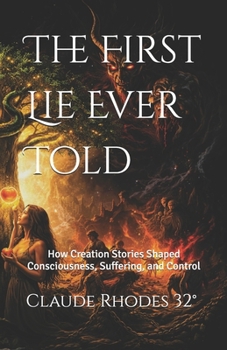
The First Lie Ever Told: How Creation Stories Shaped Consciousness, Suffering, and Control

What if the first story you were ever told was not about where you came from-but about what you are allowed to know?
The First Lie Ever Told challenges one of the most accepted assumptions in human history: that creation stories exist to explain origin. Instead, this book presents a precise and unsettling argument-these narratives were designed to define awareness, justify suffering, establish authority, and set limits on human understanding.
Across cultures and civilizations, the same pattern appears.
From the Enuma Elish to the Egyptian Creation Myths, and into the Book of Genesis, the structure does not change:
Awareness emergesA boundary is definedAuthority respondsConsequence is imposedThis is not coincidence.
It is a system.
Rather than treating these stories as isolated religious truths, this book analyzes them as structured frameworks that organize human experience. It shows how knowledge becomes disobedience, how suffering is assigned meaning, and how authority is established before human choice ever begins.
At the center of the argument is a critical shift:
If awareness is what triggers consequence, then awareness itself has been framed as a problem.
And once that framing is accepted, it shapes everything-belief, behavior, and the limits of what can be questioned.
This book breaks down:
Why creation stories prioritize consequence over originHow knowledge is transformed into violation across culturesThe role of authority in defining boundaries before actionHow suffering is explained, justified, and normalizedWhy questioning itself becomes restricted within the systemIt also explores the one major rupture in this pattern-Gnostic thought-where knowledge is no longer treated as disobedience, but as liberation, exposing that meaning is not inherent.
It is assigned.
Written in a clear, controlled, and investigative style, this book does not rely on belief or external authority. It builds a logical case that forces the reader to confront the structure directly.
This is not a book about religion.
It is a book about how meaning is constructed-and how that construction shapes what you think, what you question, and what you accept without realizing it.
If you are interested in:
Biblical analysis and historical contextComparative mythology and ancient narrativesPhilosophy of consciousness and human awarenessReligious critique and structural analysisGnostic perspectives and alternative interpretationsThen this book will challenge how you understand all of them.
Because once you see the pattern, it cannot be unseen.
And once you question the structure, the question is no longer what you believe-
but why you were taught to believe it that way.
Customer Reviews
ThriftBooks ® and the ThriftBooks ® logo are registered trademarks of Thrift Books Global, LLC
