


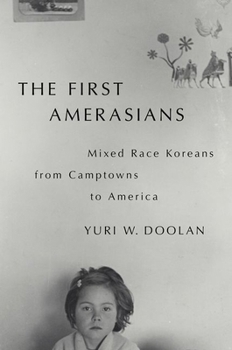
The First Amerasians: Mixed Race Koreans from Camptowns to America
No Customer Reviews

Select Format
Select Condition 
Book Overview
In the years surrounding the Korean War, thousands of mixed race children were born to American servicemen and local women in US-occupied South Korea. Assumed to be the children of camptown women--or military prostitutes--their presence posed a serious problem for the image of US democracy at a time when the nation was vying for Cold War allegiances abroad. As these children became increasingly visible around US bases, communists pointed to those left behind by their GI fathers as evidence of US imperialism, irresponsibility, and immorality in the Third World. Aware of this criticism, US citizens involved in South Korea's postwar recovery launched a campaign to bring as many of these children as possible to the United States. By the early 1960s, these philanthropists, missionaries, and voluntary agencies had succeeded in constructing the figure of the abandoned and mistreated Amerasian orphan to lobby for the swift passage of international adoption legislation. They also won the sympathies of many American families eager to welcome these racially different children into the intimate confines of their homes. But while the adoptions of mixed race Koreans promoted an image of humanitarian rescue and Cold War racial liberalism in 1950s and 1960s America, there was another problem: many of these children were not actually orphans but had been living with their mothers in the camptown communities surrounding US bases. Their placement in American families relied on dehumanizing portrayals of Korean women as prostitutes incapable of loving their own children, depictions of South Korea as a racist society bent on Confucian tradition and pure bloodlines, and narratives of the United States as a welcoming home in an era of intense racial segregation. The First Amerasians tells the powerful, oftentimes heartbreaking story of how Americans created and used the concept of the Amerasian to remove thousands of mixed race children from their Korean mothers to adoptive US homes during the 1950s and 1960s. In recovering this history, Yuri W. Doolan reveals how the Amerasian is not simply a mixed race person fathered by a US serviceman in Asia, nor a racial term used to describe individuals with one American and one Asian parent like its popular definition suggests. Rather, the Amerasian is a Cold War construct whose rescue has been utilized to repudiate accusations of US imperialism and achieve sentimental victories in the aftermath of wars not quite won by the military--beginning with Korea. From such constructions, Americans helped create the world's largest international adoption program, which expanded beyond mixed race Koreans to include children of full Korean parentage, placing nearly 200,000 children in the United States and other Western countries. After US defeat in Vietnam, the plight of mixed race Koreans was invoked once more in support of Amerasian immigration legislation, resulting in the migration of tens of thousands of mixed race Vietnamese and their relatives to the United States. Beyond Cold War historiography, this book also shows how in constructing Amerasians and orchestrating their rescue, Americans caused tangible harm to real people. Mixed race children were placed in adoptive homes at a time when few safeguards protected them from abuse, neglect, or racial hostility in the United States, and many Korean mothers were coerced--emotionally, physically, and financially--into relinquishing their children to US authorities.
Format:Paperback
Language:English
ISBN:0197534392
ISBN13:9780197534397
Release Date:March 2024
Publisher:Oxford University Press
Length:264 Pages
Weight:0.80 lbs.
Dimensions:0.7" x 5.9" x 8.9"
Customer Reviews
0 rating
Copyright © 2026 Thriftbooks.com Terms of Use
| Privacy Policy | Do Not
Sell/Share My Personal Information | Cookie Policy | Cookie Preferences | Accessibility Statement
ThriftBooks® and the ThriftBooks® logo are registered trademarks of Thrift Books Global, LLC
ThriftBooks® and the ThriftBooks® logo are registered trademarks of Thrift Books Global, LLC
