


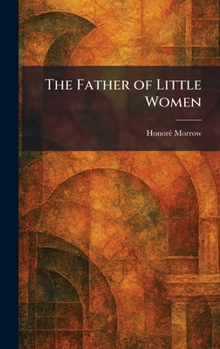
The Father of Little Women

"The Father of Little Women" is a compelling biographical study of Amos Bronson Alcott, a visionary educator, philosopher, and the father of the world-renowned author Louisa May Alcott. Written by Honor Morrow, this work delves into the complex life of a man who was both a central figure in the American Transcendentalist movement and a radical reformer whose ideas often placed him at odds with the conventional society of the 19th century.
The narrative explores Alcott's deep intellectual connections with contemporaries like Ralph Waldo Emerson and Henry David Thoreau, while also highlighting his unconventional approach to pedagogy and his unwavering commitment to his ideals, even in the face of poverty and public misunderstanding. Morrow provides an intimate look at the Alcott household, revealing how Bronson's spiritual and intellectual pursuits shaped the lives and creative output of his daughters, particularly the author of "Little Women". This biography serves as an essential portrait of a profound thinker whose influence extended far beyond his immediate family, offering readers a rich perspective on the cultural and philosophical landscape of Concord and the broader United States during a transformative era.
This work has been selected by scholars as being culturally important, and is part of the knowledge base of civilization as we know it. This work was reproduced from the original artifact, and remains as true to the original work as possible. Therefore, you may see the original copyright references, library stamps (as most of these works have been housed in our most important libraries around the world), and other notations in the work.
This work is in the public domain in the United States of America, and possibly other nations. Within the United States, you may freely copy and distribute this work, as no entity (individual or corporate) has a copyright on the body of the work.
As a reproduction of a historical artifact, this work may contain missing or blurred pages, poor pictures, errant marks, etc. Scholars believe, and we concur, that this work is important enough to be preserved, reproduced, and made generally available to the public. We appreciate your support of the preservation process, and thank you for being an important part of keeping this knowledge alive and relevant.
Customer Reviews
ThriftBooks ® and the ThriftBooks ® logo are registered trademarks of Thrift Books Global, LLC
