


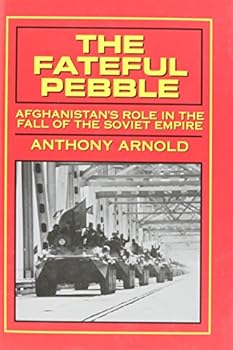
The Fateful Pebble: Afghanistan's Role in the Fall of the Soviet Empire


A foreward by Theodore L. Eliot, Jr , U.S. Amassador to Afghanistan, 1873-78. The author "demonstrates that the Afghan war was one of the key factors in causing the disintegration of the Soviet... This description may be from another edition of this product.
Format:Hardcover
Language:English
ISBN:0891414614
ISBN13:9780891414612
Release Date:January 1993
Publisher:Presidio Pr
Length:225 Pages
Weight:1.15 lbs.
Dimensions:9.5" x 1.0" x 6.3"
Customer Reviews
1 rating
Political Details of Late USSR Foreign Policy
Published by Thriftbooks.com User , 20 years ago
This book details the political forces in play as the USSR was heading for collapse. Arnold begins his book with a quote from George Stewart, "A dead-tired man may stumble over a pebble and fall; but his weariness, rather than the pebble, is the cause." In this book, Arnold, a retired CIA political analyst, argues that the war in Afghanistan was the pebble that brought down the weary man, the USSR. He analyzes the political quagmire in the USSR during the 1970s that led to the invasion of Afghanistan. He then explains how the negative worldwide political response to the invasion weakened the confidence in the government, and lessened the fear of the KGB amongst the people of the USSR. When the war dragged on, the country found its resources overextended, and without public support for the government or the war, there was no hope of establishing stability within Afghanistan. Indeed, the draw on resources for the war hastened the decline in public confidence for the government of the USSR, eventually leading to the coup attempt and collapse of the communist government. Sources of the material are varied, from newspaper articles to published interviews, all cited with endnotes that appear following each chapter. There is also an extensive bibliography at the end of the book, and an index, as well as a much needed list of acronyms and abbreviations. Many readers will find this list essential, since the text is similar to official Soviet style in being filled with acronyms, often used without explanation. It probably would have been more useful to put the list at the beginning of the book so that readers could know that it was available for reference before slogging their way to the end of the text unassisted. The book was written in the early 1990s, and covers events through early 1992, so there is no mention of the Taliban or the nightmare that was still to come for Afghanistan. Although the book includes a few chapters about the Afghan government before and during the Soviet invasion, most of the book is about the political forces in the USSR during the same time period. The text is rather dry, written mostly for those interested in an analysis of the political history of the USSR. I had picked up the book after reading Rashid's excellent account of the Taliban years, entitled "Taliban", where he notes that the Muslim world considers the fall of the Soviet Union a victory due to their efforts in supporting the Afghan resistance. Arnold's take is a little different. He acknowledges that the losses in Afghanistan were the final blow for the Soviet government, but argues that the political situation in the USSR was so bad that if the Afghan war hadn't happened, something else might have achieved the same results, and that the Soviets never would have entered Afghanistan at all if the political situation in the USSR hadn't been so desperately out of touch with reality. In any case, this is very much a book about the USSR, and not a
Copyright © 2026 Thriftbooks.com Terms of Use
| Privacy Policy | Do Not
Sell/Share My Personal Information | Cookie Policy | Cookie Preferences | Accessibility Statement
ThriftBooks® and the ThriftBooks® logo are registered trademarks of Thrift Books Global, LLC
ThriftBooks® and the ThriftBooks® logo are registered trademarks of Thrift Books Global, LLC
