


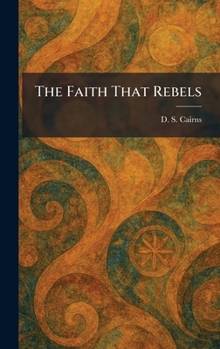
The Faith That Rebels

In "The Faith That Rebels", D.S. Cairns presents a profound re-examination of the miracles of Jesus, challenging the deterministic worldviews that dominated early twentieth-century thought. Cairns argues that the miracles recorded in the Gospels are not merely historical curiosities or violations of natural law, but are fundamental expressions of a faith that refuses to accept the limitations of a purely material existence. By exploring the relationship between the spiritual and the physical, the author suggests that faith possesses a transformative power that "rebels" against the perceived constraints of a closed universe.
This scholarly yet accessible work delves into the theological significance of divine intervention and the efficacy of prayer. Cairns situates the ministry of Jesus within a framework where the power of God is actively engaged with human suffering and the natural world. "The Faith That Rebels" remains a significant contribution to Christian theology, offering readers a compelling vision of a dynamic, living faith that seeks to reclaim the spiritual agency found in the New Testament. It is an essential read for those interested in the philosophy of religion, the nature of miracles, and the ongoing dialogue between faith and scientific materialism.
This work has been selected by scholars as being culturally important, and is part of the knowledge base of civilization as we know it. This work was reproduced from the original artifact, and remains as true to the original work as possible. Therefore, you may see the original copyright references, library stamps (as most of these works have been housed in our most important libraries around the world), and other notations in the work.
This work is in the public domain in the United States of America, and possibly other nations. Within the United States, you may freely copy and distribute this work, as no entity (individual or corporate) has a copyright on the body of the work.
As a reproduction of a historical artifact, this work may contain missing or blurred pages, poor pictures, errant marks, etc. Scholars believe, and we concur, that this work is important enough to be preserved, reproduced, and made generally available to the public. We appreciate your support of the preservation process, and thank you for being an important part of keeping this knowledge alive and relevant.
Customer Reviews
ThriftBooks ® and the ThriftBooks ® logo are registered trademarks of Thrift Books Global, LLC
