


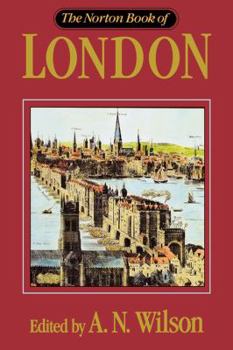
Norton Book of London

Select Format
Select Condition 
Book Overview
London has always been much more than a capital city. Its allure is so powerful that the city of monarchs and merchants once prompted Samuel Johnson to declare, When a man is tired of London, he is tired of life. From the Great Fire of 1666 to the Blitz of World War II, from the building of the Tower of London to the building of Canary Wharf, this prodigious city has long stood at the heart of English national life. At one time the center of the greatest mercantile empire the world has ever known, today London remains one of the major financial hubs of the world, as well as one of the most interesting tourist destinations in the English-speaking world. In this fascinating trip through time and space, celebrated biographer and novelist A. N. Wilson gathers a collection of literature that reflects not merely a sense of place but also the teeming variety of the town that, in its very refusal to be defined, so consistently captures the world's interest. The Norton Book of London views the city through the eyes of writers as various as Dickens and Joe Orton, Dostoyevsky and Lenin, Boswell and Martin Amis. We see criminal London, low life and high life, beggars and politicians, royal families, intellectuals and animals, in a wonderful portrait that celebrates London both past and present. From Black Beauty to Virginia Woolf, Wilson has scoured the shelves for a rich potpourri of the familiar, the diverting, and the strange.
Format:Hardcover
Language:English
ISBN:0393036316
ISBN13:9780393036312
Release Date:March 1995
Publisher:Norton & Company, Incorporated, W. W.
Length:484 Pages
Weight:1.72 lbs.
Dimensions:1.3" x 5.9" x 9.3"
Customer Reviews
1 rating
A worthy collection
Published by Thriftbooks.com User , 23 years ago
I first became acquainted with the writings of A.N. Wilson through his biographies of Jesus and Paul (being a theology student, naturally those would come across my desk first). However, I was very pleased to find that he was editor in charge of the Norton Book of London, which is a good companion volume to the Oxford Book of London (see my review of that as well).Whereas most histories and anthologies of London are organised by date order, this one is a categorical collection. We have sections in this book on Monuments, Place Names, Animals, Characters, Royal London, Seedy London, et al.Wilson takes almost the whole of English-language output as possible source materials, almost as if he did (in the days before the internet, no less) a global search on the word 'London' and then extracted the best for this collection. Some are very obscure, others famous.This is a book difficult to encapsulate. Perhaps a highlight of one section will suffice to show the structure of the whole. The section 'They came as strangers' explores the impressions of visitors and exiles to London. It includes excerpts from letters, novels, diaries and essays by the likes of Casanova, Goldsmith (describing a Chinese man's visit), Pepys (who states that Londoners love the Spanish and hate the French), Markino (a Japanese artist in London, 1910), Stendhal, Mazzini, Lenin & Trotsky (Lenin was particularly perplexed by the radical and conservative elements at mix in the proletariat of London), Carlyle, James, and Voltaire (who commented on Descartes and Newton: 'Very few people in London read Descartes, whose works, practically speaking, have become out of date. Very few read Newton, either, because much knowledge is necessary to understand him.'). These glimpses weave a wonderful pattern that slowly merges together into a rich vision of London.Many have extolled the virtues of London, but perhaps none so well as Johnson (as quoted in Boswell): 'Why, Sir, you find no man, at all intellectual, who is willing to leave London. No, Sir, when a man is tired of London, he is tired of life; for there is in London all that life can afford.'
Copyright © 2026 Thriftbooks.com
Terms of Use | Privacy Policy | Do Not Sell/Share My Personal Information | Cookie Policy | Cookie Preferences | Accessibility Statement
ThriftBooks ® and the ThriftBooks ® logo are registered trademarks of Thrift Books Global, LLC
ThriftBooks ® and the ThriftBooks ® logo are registered trademarks of Thrift Books Global, LLC
