
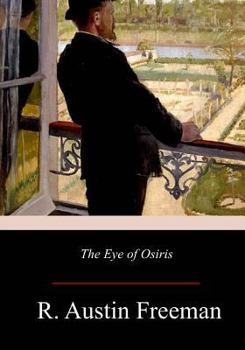
"The Eye of Osiris" is a cornerstone of the scientific detective genre, featuring the meticulous Dr. John Thorndyke. When the renowned Egyptologist John Bellingham vanishes without a trace, leaving his estate in legal limbo, a complex mystery begins to unfold. Two years later, a collection of human remains is discovered inside an ancient Egyptian sarcophagus at the British Museum, leading to a profound inquiry into identity, time, and foul play.
R. Austin Freeman showcases his expertise in forensic science and logical deduction, as Thorndyke utilizes the burgeoning field of medical jurisprudence to solve a case that seems impossible. The narrative masterfully blends elements of the classic whodunit with a fascinating exploration of archaeology and early 20th-century scientific methods. As Thorndyke parses through legal complexities and physical evidence, the reader is treated to a high-stakes investigation where the smallest detail can reveal the most chilling truths.
This work remains a significant entry in the history of detective fiction, celebrated for its realism and intellectual depth. "The Eye of Osiris" captures the atmospheric tension of London and the intrigue of ancient secrets, making it an essential read for fans of traditional mysteries and forensic investigation.
This work has been selected by scholars as being culturally important, and is part of the knowledge base of civilization as we know it. This work was reproduced from the original artifact, and remains as true to the original work as possible. Therefore, you may see the original copyright references, library stamps (as most of these works have been housed in our most important libraries around the world), and other notations in the work.
This work is in the public domain in the United States of America, and possibly other nations. Within the United States, you may freely copy and distribute this work, as no entity (individual or corporate) has a copyright on the body of the work.
As a reproduction of a historical artifact, this work may contain missing or blurred pages, poor pictures, errant marks, etc. Scholars believe, and we concur, that this work is important enough to be preserved, reproduced, and made generally available to the public. We appreciate your support of the preservation process, and thank you for being an important part of keeping this knowledge alive and relevant.

