


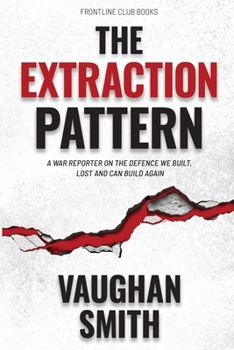
The Extraction Pattern: A war reporter on the defence we built, lost and can build again

From 1988 to 2012 Vaughan Smith reported the world's wars. He came back with a question the front line kept asking: why do a few people, in every walk of life, take everything and answer for nothing, and why do the rest of us let them?
The Extraction Pattern is his answer.
A small minority in any population run a behaviour that takes more than it gives. For two hundred thousand years villages held it in check by proximity and reputation, because everyone could see what everyone else took. Industrial scale broke that containment, and we have lived in the wreckage since, in captured markets, captured institutions and captured states.
The answer is not better people. In 1876, after too many sailors had drowned in ships deliberately overloaded and heavily insured, Parliament made Samuel Plimsoll's line law: a mark on every hull past which it could not be loaded, and fourteen years later the law fixed where the mark went. It did not ask shipowners to reform. It made the taking visible to anyone standing on the dock. That, Smith argues, and not virtue, is what a society has to rebuild.
Drawing on twenty-four years of reporting and on the neuroscience of trust, The Extraction Pattern names a behaviour rather than diagnosing a person, and follows it from a marriage to a government. It is not a counsel of despair. What proximity once did, design can do again.
Contain the pattern. Regard the person.
For readers of On Tyranny, Why Nations Fail and The Shock Doctrine.
With a foreword by Professor Katalin Gothard, University of Arizona.
Vaughan Smith is a journalist and former war reporter, and the founder of London's Frontline Club.
Customer Reviews
ThriftBooks ® and the ThriftBooks ® logo are registered trademarks of Thrift Books Global, LLC
