


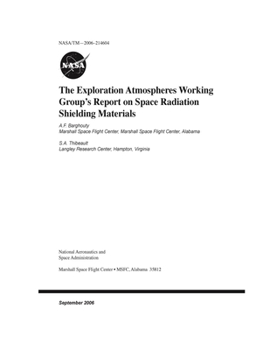
The Exploration Atmospheres Working Group's Report on Space Radiation Shielding Materials
No Customer Reviews

This part of Exploration Atmospheres Working Group analyses focuses on the potential use of nonmetallic composites as the interior walls and structural elements exposed to the atmosphere of the spacecraft or habitat. The primary drive to consider nonmetallic, polymer-based composites as an alternative to aluminum structure is due to their superior radiation shielding properties. But as is shown in this analysis, these composites can also be made to combine superior mechanical properties with superior shielding properties. In addition, these composites can be made safe; i.e., with regard to flammability and toxicity, as well as "smart"; i.e., embedded with sensors for the continuous monitoring of material health and conditions. The analysis main conclusions are that (1) smart polymer-based composites are an enabling technology for safe and reliable exploration missions, and (2) an adaptive, synergetic systems approach is required to meet the missions requirements from structure, properties, and processes to crew health and protection for exploration missions. Barghouty, A. F. and Thibeault, S. A. Langley Research Center; Marshall Space Flight Center NASA/TM-2006-214604, M-1173 RADIATION SHIELDING; EXTRATERRESTRIAL RADIATION; FLAMMABILITY; TOXICITY; SPACECREWS; AEROSPACE MEDICINE; HABITATS; PROTECTION
Format:Paperback
Language:English
ISBN:B08F9V9JQK
ISBN13:9798672406268
Release Date:January 1
Publisher:Independently Published
Length:32 Pages
Weight:0.22 lbs.
Dimensions:0.1" x 8.5" x 11.0"
Customer Reviews
0 rating
Copyright © 2026 Thriftbooks.com Terms of Use
| Privacy Policy | Do Not
Sell/Share My Personal Information | Cookie Policy | Cookie Preferences | Accessibility Statement
ThriftBooks® and the ThriftBooks® logo are registered trademarks of Thrift Books Global, LLC
ThriftBooks® and the ThriftBooks® logo are registered trademarks of Thrift Books Global, LLC
