


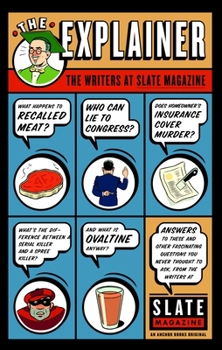
The Explainer

What happens to recalled meat? What's the difference between a serial killer and a spree killer? How do you stop a lava flow? Does homeowner's insurance cover murder? And what is Ovaltine anyway? Answers to these and other fascinating questions you never thought to ask, from the writers at Slate Magazine An entertaining and genuinely informative compilation of answers to some of life's most improbable questions, from the writers of the online magazine Slate. Often inspired by events in the news, the "Explainer" column asks the questions we never think to ask, or that we're too embarrassed to admit we don't know how to answer. Filling in these overlooked blanks of our daily lives, the book provides memorable tidbits for conversations, further rumination, or important context as we follow current events from day to day. Full of fascinating information about unlikely but important subjects, The Explainer will entertain and inform anyone who has ever stopped to wonder who runs Antarctica, how cell phones can reveal your location, or whether one can live off lizard meat.
Format:Paperback
Language:English
ISBN:1400034264
ISBN13:9781400034260
Release Date:March 2004
Publisher:Anchor Books
Length:272 Pages
Weight:0.45 lbs.
Dimensions:0.6" x 5.2" x 8.1"
Customer Reviews
5 ratings
SO MUCH INFORMATION
Published by Thriftbooks.com User , 20 years ago
Quite literally corresponding with the title of the book, "The Explainer" answers and explains questions you can't easily find answers to. This book deals with issues that are commonly addressed in the news or in the paper, and extrapolates them with more detail.For example, remember this year when Pope died? I always kept thinking to myself, why didn't he just retire if he was so sick he could barely sit up. This book answered my question, "Can a Pope Retire?" which I found the answer to. Also, it is written with easy language, so that the reader without any background knowledge wold comprehend. This book is categorized into various sections so you can choose which issues that you want to read about. I found "Strange Careers" and "What's the Difference?" categories particularly interesting. You can learn about how much you'd be paid if you were a talk-show guest at the Oprah show, or what exactly is the difference between genocide and "crime against humanity". You can learn about the subtle differences in words (like CEO and Chairman) and question why Bush says "nucular" instead of nuclear. Just have a read through it and you will be shocked how much this book can tell you. This is a great guide to understanding more about the world and once you breeze through it, things on the news will begin to make more sense. AND you can brag off to your friends, you know?
The Explainer by Curbs et al.
Published by Thriftbooks.com User , 21 years ago
This book covers practically every uncommon phenomenon known to humankind. For instance, the authors explain how to slow down lava in a volcano. The traceability of cell phones by tower records is described in technical detail. Recess appointments by government officials are explained as to their timing and cause. The contents of this work would provide good conversation at any party or informal social gathering. For this reason alone, the volume is worth the price of admission.
If you wanted to know, but were too afraid too ask
Published by Thriftbooks.com User , 21 years ago
The premise of this book is great: The news (print, TV, magazine, and internet) puts out stories with assumed facts in there, yet most people don't know the basis for these facts, since there is just too much information out there for everyone to know. For example, one always hears about some great blizzard, and that 5 inches of snow was layed down. If you are like me, you have heard this, or something similar, many, many times, and you know what it means, but yet you have no idea exactly how they figured out that 12 inches of snow fell last night. Well, this book answers that question.Another great example is the essay on how corking a bat helps a batter. One not only learns how a bat is corked and how it helps the batter's performance, but you also learn that a corked bat would probably DECREASE the distance of Sammy Sosa's hits. (This has to do with the physics equation p=mv, momentum = mass x velocity. Since a corked bat weighs less than an uncorked one, the momentum for a corked bat, assuming the same velocity for both, will be less than for an uncorked one.)If you like trivia books, this is definitely a keeper; if you don't like the normal run-of-the-mill trivia books, you will probably like this one, since it isn't your standard question and answer book that lays out the facts without any cultural/political/real-life relevance. Who doesn't want to know what happens to your social security number when you die. Is it retired, or recycled? Read the book, and you'll find out.
A fun and informative read
Published by Thriftbooks.com User , 21 years ago
I read this all the way through, which I suppose is a statement about how well it's written and edited. It's a splendid example of how good writing, good editing and some excellent research can lead to a felicitous read. The people at Slate did themselves proud as they swam between the shallows of the sound byte and the depths of the essay. Let's say that what we have here--and what is increasingly seen in the print and Internet media (including this review)--is something we might call the mini-essay, between five hundred and a thousand words--that is, longer than the buzz on TV but shorter than an article from Harper's or The Atlantic Monthly.Here's an example of the clear, effective writing with just a touch of panache that characterizes this modest volume. The writers are discussing how and why Supreme Court Justices recuse themselves (something Justice Scalia ought to do in the case before the court involving his good buddy Dick Chaney): "Since Supreme Court justices tend to be well off, and since lawyers often marry lawyers and beget more lawyers, money and family come up the most as reasons for recusal." (p. 172) In the next paragraph, we are given the probable reason that Scalia is not recusing himself: "In general justices are loath to recuse themselves from cases because it opens the way for a tie. When that happens, the lower court decision is affirmed by default." Hmm, maybe we can predict if a justice, leaning a certain way, is likely to recuse himself by looking at how the lower court ruled.It is this kind of additional insight into the question at hand that lifts the people at Slate above some other "explainers" that I have read. Here's another nice example from the double-edged question, "How Does the US Mint Make Money?" It makes it two ways, the authors slyly explain. First it manufactures the actual coins, which is one way of "making" money; and then it makes money by putting the coins into circulation, which is another way of "making" money since the banks have to pay for them. But the zinger is what economists aptly call "escheatment" (a word Slate doesn't use here). Simply put, escheatment is the profit the government gains from all the coins and bills that are lost or destroyed. For the loser that money just disappears. For the government that money is money it got paid for, and unless the coins or bills are found, it is money that it never has to redeem. Banks issuing digital credit cards also benefit from escheatment when the cards or lost or destroyed before being emptied. Traditionally, escheatment refers to governments benefitting from people who die without heirs.I was startled to read that the US Mint "estimates that in the first two and a half years [of the commemorative quarters program with states featured on the quarters]...it bagged nearly $3-billion in revenue off quarters alone." (p. 215)Naturally, I can find some wee fault with this book. In explaining how to spell "Osama" and why authorities
My Second Favorite Slate Feature
Published by Thriftbooks.com User , 21 years ago
The Explainer is a regular feature of the online magazine, Slate. It answers questions you have about the current news, such as what is a spiderhole and how did it get its name? Or how do you pronounce Abu Ghraib? These questions and their answers aren't in the book, but you can find them in the archives of Slate.The book compiles some of the more intriguing questions from the past few years, such as Could Bill Clinton become president again? (The short answer is yes, but don't hold your breath.) Who can be buried at Arlington Cemetery? What happens if you don't answer the census questionnaire?Slate's reporters, in response to reader questions and often their own curiosity, find experts in the appropriate field and ask the question. They make the expert explain the answer until they understand it, then write a short column explaining the answer to their readers. In this way, we learn how to pronounce Niger, how to become a weapons inspector, and what is Ovaltine, anyway.The Explainer is a compact book that is fun to read in small doses or all at once. The explanations are only about a page or two each and clustered into about two dozen short chapters such as Dining Out, Medicine, Flight, and Death. Although I usually read the Explainer online, I thought I'd catch a few that I'd missed. Either I missed a lot of these explanations or I have a really poor memory. Regardless, I enjoyed reading these Explainer columns and look forward to more Slate publications.(My favorite Slate feature is Bushisms.)
Copyright © 2026 Thriftbooks.com Terms of Use
| Privacy Policy | Do Not
Sell/Share My Personal Information | Cookie Policy | Cookie Preferences | Accessibility Statement
ThriftBooks® and the ThriftBooks® logo are registered trademarks of Thrift Books Global, LLC
ThriftBooks® and the ThriftBooks® logo are registered trademarks of Thrift Books Global, LLC
