


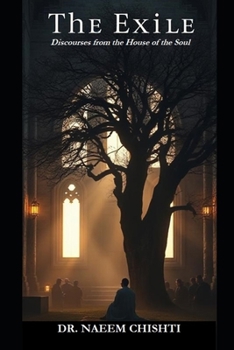
The Exile: Discourses from the House of the Soul
No Customer Reviews

Book Description - The Exile: Discourses from the House of the Soul
In a forgotten corner of a northern English town stands a building without bells - a quiet sanctuary called Bayt al-Rūh, The House of the Soul. Once a disused church, it was restored not into a mosque, nor a temple, but into a dwelling of silence, reflection, and communion. Here, beneath its vaulted stone arches and soft candlelight, Aalim, a teacher, poet, and exile, gathers seekers of every kind - students, wanderers, widows, scholars, and skeptics - each carrying the ache of distance and the hunger for meaning.
The Exile: Discourses from the House of the Soul is a work of luminous stillness - a book of philosophical dialogues, poetic meditations, and spiritual parables that explore the perennial questions of belonging, faith, identity, and the divine. Written in a voice both tender and timeless, it continues the lineage of writers like Khalil Gibran, Rumi, and Ibn Arabi, blending the mysticism of the East with the inward searching of the modern soul.
Structured in fifteen chapters, the book unfolds through a rhythm of question and response. Each chapter begins with a Dialogue Prelude - a scene in which a townsman or traveler approaches Aalim with a question born of life's tension and tenderness: How do we belong when our roots are scattered? What is the self beneath its many masks? Where is God when silence feels unbearable? How can love survive in a world of noise and distance?
Aalim's replies do not come as doctrine, but as conversation - gentle, poetic, and illuminated by metaphor. From there, each chapter deepens into three Discourses, where his reflections expand like ripples across a still pond. Themes unfold in meditative sequence - from Belonging, Identity, and Faith, to Freedom, Grief, Justice, and Departure - tracing the arc of the human spirit from exile to return, from fragmentation to wholeness.
At the heart of The Exile lies the recognition that exile is not only a geographical condition but a spiritual one. To be human, Aalim suggests, is to live in a state of gentle estrangement - from our origins, from each other, and at times from ourselves. Yet it is within this very exile that awakening begins. "Every exile," he teaches, "is a bridge back to the self."
More than a collection of reflections, the book is a mirror - one that invites the reader to listen inwardly, to rediscover the stillness within the noise of the world. Its language is musical yet measured, weaving the cadence of scripture with the intimacy of lived experience. Its imagery draws from both the Sufi imagination and the modern landscape - rain on cobblestones, the hum of digital lives, the silence of a night sky - grounding mysticism in the immediacy of the everyday.
For readers of Rumi, Gibran's The Prophet, or Marcus Aurelius's Meditations, The Exile offers a timeless encounter between poetry and philosophy, between soul and society. It is a book to be read slowly - not merely understood but felt - a companion for those who walk between cultures, faiths, or identities, and for anyone who has ever asked where home truly lies.
In the end, The Exile is not about Aalim alone, nor the seekers who gather around him. It is about us - our longing to belong, our search for truth amid noise, and our hope that beyond all departures there awaits a return, not to a place, but to presence itself.
Aalim's final words linger like a benediction over the reader's heart:
"I go not to leave you, but to find you where words no longer wander."
In a forgotten corner of a northern English town stands a building without bells - a quiet sanctuary called Bayt al-Rūh, The House of the Soul. Once a disused church, it was restored not into a mosque, nor a temple, but into a dwelling of silence, reflection, and communion. Here, beneath its vaulted stone arches and soft candlelight, Aalim, a teacher, poet, and exile, gathers seekers of every kind - students, wanderers, widows, scholars, and skeptics - each carrying the ache of distance and the hunger for meaning.
The Exile: Discourses from the House of the Soul is a work of luminous stillness - a book of philosophical dialogues, poetic meditations, and spiritual parables that explore the perennial questions of belonging, faith, identity, and the divine. Written in a voice both tender and timeless, it continues the lineage of writers like Khalil Gibran, Rumi, and Ibn Arabi, blending the mysticism of the East with the inward searching of the modern soul.
Structured in fifteen chapters, the book unfolds through a rhythm of question and response. Each chapter begins with a Dialogue Prelude - a scene in which a townsman or traveler approaches Aalim with a question born of life's tension and tenderness: How do we belong when our roots are scattered? What is the self beneath its many masks? Where is God when silence feels unbearable? How can love survive in a world of noise and distance?
Aalim's replies do not come as doctrine, but as conversation - gentle, poetic, and illuminated by metaphor. From there, each chapter deepens into three Discourses, where his reflections expand like ripples across a still pond. Themes unfold in meditative sequence - from Belonging, Identity, and Faith, to Freedom, Grief, Justice, and Departure - tracing the arc of the human spirit from exile to return, from fragmentation to wholeness.
At the heart of The Exile lies the recognition that exile is not only a geographical condition but a spiritual one. To be human, Aalim suggests, is to live in a state of gentle estrangement - from our origins, from each other, and at times from ourselves. Yet it is within this very exile that awakening begins. "Every exile," he teaches, "is a bridge back to the self."
More than a collection of reflections, the book is a mirror - one that invites the reader to listen inwardly, to rediscover the stillness within the noise of the world. Its language is musical yet measured, weaving the cadence of scripture with the intimacy of lived experience. Its imagery draws from both the Sufi imagination and the modern landscape - rain on cobblestones, the hum of digital lives, the silence of a night sky - grounding mysticism in the immediacy of the everyday.
For readers of Rumi, Gibran's The Prophet, or Marcus Aurelius's Meditations, The Exile offers a timeless encounter between poetry and philosophy, between soul and society. It is a book to be read slowly - not merely understood but felt - a companion for those who walk between cultures, faiths, or identities, and for anyone who has ever asked where home truly lies.
In the end, The Exile is not about Aalim alone, nor the seekers who gather around him. It is about us - our longing to belong, our search for truth amid noise, and our hope that beyond all departures there awaits a return, not to a place, but to presence itself.
Aalim's final words linger like a benediction over the reader's heart:
"I go not to leave you, but to find you where words no longer wander."
Format:Paperback
Language:English
ISBN:B0FXS1CVM8
ISBN13:9798271508004
Release Date:October 2025
Publisher:Independently Published
Length:322 Pages
Weight:0.95 lbs.
Dimensions:0.7" x 6.0" x 9.0"
Customer Reviews
0 rating
Copyright © 2026 Thriftbooks.com
Terms of Use | Privacy Policy | Do Not Sell/Share My Personal Information | Cookie Policy | Cookie Preferences | Accessibility Statement
ThriftBooks ® and the ThriftBooks ® logo are registered trademarks of Thrift Books Global, LLC
ThriftBooks ® and the ThriftBooks ® logo are registered trademarks of Thrift Books Global, LLC
