


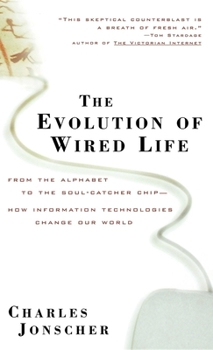
The Evolution of Wired Life: From the Alphabet to the Soul-Catcher Chip -- How Information Technologies Change Our World

Select Format
Select Condition 
Book Overview
Thoughtful and erudite... Intelligent and readable...Will appeal to people who enjoyed Longitude by Dava Sobel or Fermat's Enigma by Simon Singh. -The San Diego Union Tribune ""Most engaging.""-The Boston Globe ""An optimistic and reassuring assertion that no matter what wonders we invent, human beings . . . remain infinitely more complex and interesting.""-The Economist A lively, informative examination of the computer revolution-and why the top-performing information-processing device is still the human brain If we believe the forecasts of many computer enthusiasts, a wave of amazing devices will soon fundamentally change our lives, and the ""thinking machine"" is just around the corner. In this authoritative and entertaining book, critically acclaimed author Charles Jonscher presents the other side of the argument: while communication developments have changed society, they also have their limits. He shows us that in order to understand the true transformative powers of the new technologies, we must know about the long history of their development-and why no calculating machine can match the creative power of the human mind. Rich in insights from literature, philosophy, and history, The Evolution of Wired Life offers a fascinating look at the development of the digital era, from the invention of the first alphabetic language to the printing press to the World Wide Web.
Format:Paperback
Language:English
ISBN:0471392987
ISBN13:9780471392989
Release Date:August 2000
Publisher:Trade Paper Press
Length:304 Pages
Weight:0.78 lbs.
Dimensions:0.8" x 5.6" x 8.5"
Related Subjects
Ancient Biological Sciences Biology Business & Management Computer Science Computers Computers & Technology Culture Early Civilization Engineering Evolution History History & Philosophy Humanities Industrial, Manufacturing & Operational Systems Science Science & Math Science & Scientists Science & Technology Technology TextbooksCustomer Reviews
4 ratings
Human Brain's Upper Hand
Published by Thriftbooks.com User , 25 years ago
With his argument that humans, rather than technology, will always have the upper hand, Jonscher begins a fascinating unravelling of where the "digital age" has sprung from, with all its limitations and possibilities. While lauding the technology which could now record every moment of a human life by means of a tiny bit of silicon implanted in the brain - the apocryphal "soul-catcher" chip - he points out that the human brain has 20 billion neurons, and that: "the intelligence of a single-celled organism less evolved than a neuron, such as a paramecium, is such that it can navigate towards food and negotiate obstacles, recognise danger and retreat from it. How does your PC compare?" After a delve through the scientific theories lying behind the evolution of IT, he goes on to trace its development, with its impact on and creation of multimedia and the Internet, economic progress and the technologies of tomorrow. For anyone who has ever asked what the IT revolution is all about, and how it will affect them, this readable and authoritative account, with its occasional dashes of dry humour, will fill some of the gaps.
Excellent Material
Published by Thriftbooks.com User , 26 years ago
Even though digitalisation may seem able to unfold the very secret of life - or is at least presented that way - this book provides the counter-argument. Jonscher, obviously 'knowing his stuff', argues that there is no such thing as a computer that will fully replace a human. He starts his arguments in the microscopical level and builds his way up to the informational characteristics of today's society. Respecting the essentials in life - such as the added value of interpersonal communication in real life as opposed to that in virtual life - he creates a well though-out case in favor of mankind in the debat between human vs. computer. Giving insights into some of the secrets of sillicon valley, philosophical guidance on the Real (Plato's cave) and a factual economic description of what computers mean to professional activity, make this book a fresh breeze into the - perhaps already stagnated - discourse on what the computer and computernetworks have in stall for the (western) world. Written in a non-patronizing style - which cannot be said about a lot of authors on this topic, who perhaps by doing so admit the weakness of their arguments, you decide - Jonscher delivers one of the books that judge after the facts and not a priori. Needless to say I recommend it.
ALL ABOUT OUR THINKING BIOLOGY AND ITS DIGITAL OFFSPRING!
Published by Thriftbooks.com User , 26 years ago
This is an enormously engrossing study of the nature and evolution of the brain and of today's digital technology revolution. In examining the brain and its silicon creations, the workings, potential and uniqueness of BOTH are explored in detail, along with the challenge that computers can reach mind-like thinking with artificial intelligence, neural computing and fuzzy logic. With clarity and brilliant insights, Jonscher shows the limits of technology's reach toward mind-like thinking, making a compelling argument that no machine can ever rival the complexities and subtleties of the brain; that no digital device will ever answer a question that lies outside of the 'computable' category. Thinking is not purely mechanical, the author concludes, and the brain is something which cannot be fully understood, let alone replicated, by applying its own capacities. But this book does more than take on the Big Question -will computers ever think like people?; it opens the reader's mind to the realities of THINKING, within the dynamic context of four billion years of evolution and our evolving Knowledge Society. This is an enlightening, entertaining, and very accessible work. A powerful book that deftly handles ideas and issues of mind-challenging proportions. Very highly recommended. Reviewed by Gerry Stern and Yvette Borcia, editors of Stern's Management Review, founders, Stern & Associates and the HR Knowledge Network, authors of Stern's Sourcefinder: The Master Directory to HR and Business Management Information & Resources, Stern's CyberSpace SourceFinder, and Stern's Compensation and Benefits SourceFinder.
From carbon to silicon... humans and digital technology
Published by Thriftbooks.com User , 26 years ago
This is a great read for Lawyers and other "fuzzy" information-economy thinkers! Better yet, it's a great read for IT professionals, who are introducing technological solutions into human situations! This book will keep you grounded in reality.Charles Jonscher, through an entertaining examination of centuries accumlation of philosophy... science and technology, shows the disconnects between the they way humans interact, and the way digital technology works. In short, being digital ain't the same as being human. It ain't warm, fuzzy -- and more importantly ain't ANALOG.The beauty of ANALOG is the key to Jonscher's book. Analog thinking is by nature, superior to digital. Using mathematics and physics vis-a-vis bio-chemistry and psychology, Jonscher reveals that the human brain is analog. On the other hand, computers are digital, and hence 'inferior'.For example, Jonscher talks about Deep Blue, the computer that beat the pants off the best Chess player in the world. While the media hailed this as a significant step towards the evolution of 'computer intellegence' Jonscher puts this (off the wall) assertion into perspective. He argues that if a fire broke out during the chess match, even a lowly bumble bee would have enough "common sense" to leave the building, whereas Deep Blue would continue to play the game and burn to crisp in the flames. By tracing the path of natural evolution, Jonscher shows readers that all things natural use "analog" senses produced and guided by complex chemical reactions. While digital uses logic and mathmatics. Grounding his argument in such scientific breakthroughs as Quantum Physics, that shows that there is chaos in logic, mathmatics physics ... and (GASP) nature ... Jonscher explodes the myth of Computer Intelligence at its roots. In simple terms, Jonscher shows readers with concrete evidence that it is physically and scientifically impossible to use digital technologies to create intelligence. Computers will only be able to assist humans in matters of logic -- they cannot help your wife to decide on whether to have a hot mochachino or Orange Crush ... or tell you your neighbour is really upset that your dog just did a do-do on their front-lawn. Only human interaction via analog senses of sight, taste, smell, hearing, touch, can detect these nuances of interaction.
Copyright © 2026 Thriftbooks.com Terms of Use
| Privacy Policy | Do Not
Sell/Share My Personal Information | Cookie Policy | Cookie Preferences | Accessibility Statement
ThriftBooks® and the ThriftBooks® logo are registered trademarks of Thrift Books Global, LLC
ThriftBooks® and the ThriftBooks® logo are registered trademarks of Thrift Books Global, LLC
