


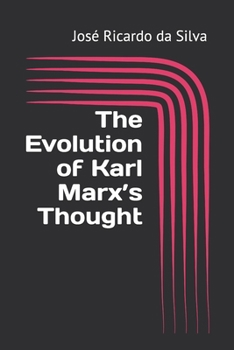
The Evolution of Karl Marx's Thought
No Customer Reviews

For over a century, Karl Marx has been a ghost story told by the victors and a sacred text guarded by the defeated. When the Berlin Wall was violently dismantled in 1989, the intellectual establishment of the West breathed a collective sigh of relief. The Cold War was won, the "end of history" was at hand, and Marx-the towering, bearded architect of communist theory-was presumably relegated to the archives of failed nineteenth-century utopianism.
Yet, history stubbornly refused to end. In the decades since, we have navigated the catastrophic 2008 global financial crisis, the explosive rise of the precarious gig economy, a yawning chasm of global wealth inequality, and a rapidly accelerating ecological crisis. In the face of these escalating shocks, a remarkably persistent spectre has returned. Not as a state-sanctioned deity, but as an urgent, highly relevant analytical voice in the pages of financial newspapers, the organizing committees of new labor unions, and the lecture halls of modern universities. We are increasingly forced to ask: What did this Victorian exile see that we are only now beginning to fully understand?
The Evolution of Karl Marx's Thought was born from a desire to answer that question by rescuing the man from the myth. For too long, engagements with Marx have been paralyzed by retrospective determinism. We have been taught to read his life backward, interpreting his nineteenth-century writings almost exclusively through the bloodstained lens of twentieth-century state socialism.
This book proposes a radically different approach: we must read him forward.
By stripping away the accumulated layers of Cold War dogma, we discover a thinker who was remarkably dynamic. The Marx you will encounter in these pages is not a static oracle handing down infallible commandments. He is a restless, profoundly empirical intellectual. Together, we will trace his evolution from a frustrated young philosopher in an autocratic Prussia, to a fiery political strategist on the barricades of the 1848 revolutions, and finally to the exhausted, obsessive researcher mapping the DNA of capitalism in the reading room of the British Museum. You will witness a man who constantly revised his own theories, abandoned failed timelines, and continually expanded his horizons.
The core premise of this book is that to understand Marx's value today, we must decouple his diagnosis from his prescription. The political cures enacted in his name during the twentieth century proved to be authoritarian disasters. But as a diagnostic physician of capitalism's structural contradictions-its inherent tendencies toward monopoly, cyclical crises, financialization, and the commodification of human life-Marx remains unsurpassed.
This book is written for the curious, critical reader. It does not demand that you agree with Marx, nor does it serve as an apology for the regimes that weaponized his theories. Rather, it offers a structured framework to engage with one of the most rigorous and consequential intellects in human history. To understand the fractured, crisis-prone world we inhabit today, we must first step into the laboratory of the mind that cracked its code.
Yet, history stubbornly refused to end. In the decades since, we have navigated the catastrophic 2008 global financial crisis, the explosive rise of the precarious gig economy, a yawning chasm of global wealth inequality, and a rapidly accelerating ecological crisis. In the face of these escalating shocks, a remarkably persistent spectre has returned. Not as a state-sanctioned deity, but as an urgent, highly relevant analytical voice in the pages of financial newspapers, the organizing committees of new labor unions, and the lecture halls of modern universities. We are increasingly forced to ask: What did this Victorian exile see that we are only now beginning to fully understand?
The Evolution of Karl Marx's Thought was born from a desire to answer that question by rescuing the man from the myth. For too long, engagements with Marx have been paralyzed by retrospective determinism. We have been taught to read his life backward, interpreting his nineteenth-century writings almost exclusively through the bloodstained lens of twentieth-century state socialism.
This book proposes a radically different approach: we must read him forward.
By stripping away the accumulated layers of Cold War dogma, we discover a thinker who was remarkably dynamic. The Marx you will encounter in these pages is not a static oracle handing down infallible commandments. He is a restless, profoundly empirical intellectual. Together, we will trace his evolution from a frustrated young philosopher in an autocratic Prussia, to a fiery political strategist on the barricades of the 1848 revolutions, and finally to the exhausted, obsessive researcher mapping the DNA of capitalism in the reading room of the British Museum. You will witness a man who constantly revised his own theories, abandoned failed timelines, and continually expanded his horizons.
The core premise of this book is that to understand Marx's value today, we must decouple his diagnosis from his prescription. The political cures enacted in his name during the twentieth century proved to be authoritarian disasters. But as a diagnostic physician of capitalism's structural contradictions-its inherent tendencies toward monopoly, cyclical crises, financialization, and the commodification of human life-Marx remains unsurpassed.
This book is written for the curious, critical reader. It does not demand that you agree with Marx, nor does it serve as an apology for the regimes that weaponized his theories. Rather, it offers a structured framework to engage with one of the most rigorous and consequential intellects in human history. To understand the fractured, crisis-prone world we inhabit today, we must first step into the laboratory of the mind that cracked its code.
Format:Paperback
Language:English
ISBN:B0H6H8VV6B
ISBN13:9798183958201
Release Date:June 2026
Publisher:Independently Published
Length:106 Pages
Weight:0.31 lbs.
Dimensions:0.3" x 6.0" x 9.0"
Customer Reviews
0 rating
Copyright © 2026 Thriftbooks.com
Terms of Use | Privacy Policy | Do Not Sell/Share My Personal Information | Cookie Notice | Cookie Preferences | Accessibility Statement
ThriftBooks ® and the ThriftBooks ® logo are registered trademarks of Thrift Books Global, LLC
ThriftBooks ® and the ThriftBooks ® logo are registered trademarks of Thrift Books Global, LLC
