


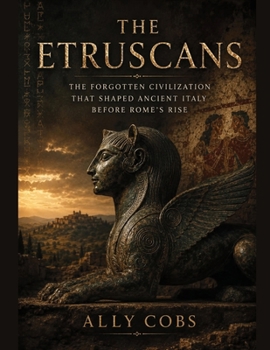
The Etruscans: The Forgotten Civilization That Shaped Ancient Italy Before Rome's Rise

Long before Rome ruled the Mediterranean, another civilization ruled Italy.
Centuries before the founding of the Roman Republic, the Etruscans built powerful city-states across central Italy, developed one of the ancient world's most sophisticated systems of religious divination, and placed a dynasty of their own kings on the throne of Rome itself. Their bronze workers, potters, and sculptors produced art admired across the Mediterranean. Their women moved through public life with a freedom that shocked Greek and Roman observers. Their sailors guarded their coastline so effectively that Greek merchants once feared to sail near their shores. And yet today, this remarkable civilization remains one of the least understood peoples of the ancient world.
The Etruscans traces this story from its earliest roots in the Villanovan culture of 900 BC through the rise of independent Etruscan city-states, their deepening contact with the Greek and Phoenician worlds, and their eventual struggle against the growing power of Rome. Drawing on ancient testimony and modern archaeological and genetic research, this book examines where the Etruscans truly came from, how their society and religion actually functioned, and why a civilization of such wealth and sophistication ultimately could not withstand the rise of the empire it once ruled.
Readers will discover how Etruscan kings shaped the earliest history of Rome, how Etruscan religious practice developed an elaborate system for interpreting the will of the gods, and how a language unlike any other in the ancient Mediterranean world flourished for centuries before disappearing almost entirely. The book explores the daily lives of Etruscan women, the organization and equipment of Etruscan armies, the trade networks that carried Etruscan goods as far as Spain and the Rhine, and the artistic achievements, from tomb paintings to bronze sculpture, that continue to offer a window into how the Etruscans actually lived.
More than a catalogue of dates and battles, this book explains why the Etruscans mattered, both to their own time and to the civilization that eventually absorbed them. It considers what their political fragmentation cost them, what their religious worldview reveals about how they understood their place in the world, and what remains of their legacy within the foundations of Roman, and by extension Western, civilization.
For readers interested in ancient history, the origins of Rome, or the forgotten civilizations that shaped the classical world, this book offers a clear and engaging introduction to a people whose achievements have waited far too long to be properly told.
Related Subjects
HistoryCustomer Reviews
ThriftBooks ® and the ThriftBooks ® logo are registered trademarks of Thrift Books Global, LLC
