


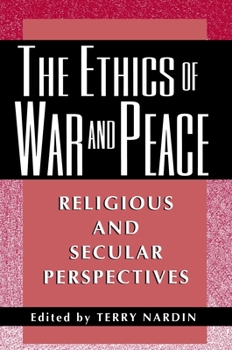
The Ethics of War and Peace: Religious and Secular Perspectives (Ethikon Series in Comparative Ethics)

Select Format
Select Condition 
Book Overview
A superb introduction to the ethical aspects of war and peace, this collection of tightly integrated essays explores the reasons for waging war and for fighting with restraint as formulated in a diversity of ethical traditions, religious and secular. Beginning with the classic debate between political realism and natural law, this book seeks to expand the conversation by bringing in the voices of Judaism, Islam, Christian pacifism, and contemporary feminism. In so doing, it addresses a set of questions: How do the adherents to each viewpoint understand the ideas of war and peace? What attitudes toward war and peace are reflected in these understandings? What grounds for war, if any, are recognized within each perspective? What constraints apply to the conduct of war? Can these constraints be set aside in situations of extremity? Each contributor responds to this set of questions on behalf of the ethical perspective he or she is presenting. The concluding chapters compare and contrast the perspectives presented without seeking to adjudicate their differences. Because of its inclusive, objective, comparative, and dialogic approach, the book serves as a valuable resource for scholars, journalists, policymakers, and anyone else who wants to acquire a better understanding of the range of moral viewpoints that shape current discussion of war and peace. In addition to the editor, the contributors are Joseph Boyle, Michael G. Cartwright, Jean Bethke Elshtain, John Finnis, Sohail H. Hashmi, Theodore J. Koontz, David R. Mapel, Jeff McMahan, Richard B. Miller, Aviezer Ravitzky, Bassam Tibi, Sarah Tobias, and Michael Walzer.
Format:Hardcover
Language:English
ISBN:0691037132
ISBN13:9780691037134
Release Date:February 1996
Publisher:Princeton University Press
Length:296 Pages
Weight:0.90 lbs.
Dimensions:9.8" x 1.0" x 6.5"
Customer Reviews
1 rating
When the circle ends to turn around itself !
Published by Thriftbooks.com User , 19 years ago
The aroused controversy on different international stages, around the powerful meaning of the justice as secular idea, collides with the war in more than an aspect. The overpopulation, and many others issues generated by very well known consequences by "the greenhouse effect", may not ignore the opinion of the religious views. If we assume we are living in a challenging and changing world, the innovativeness appears as vital resource to face every one of the unthinkable consequences derived from this process of evolution, where the breakthrough of the paradigms affects continuously our own convictions, and at least to my view, you have to be absolutely centered about your bliss in the life; if not I ' m afraid no other solution will be precisely comfortable or permanent. In this state of things what' must be the role of religion and moreover, in what level may contribute and make its voice be listened. If we analyze the emotional nature of the human being in comparison with our first ancestors, there's not a remarkable difference and that fact doesn't' seem to be a good signal. Regardless your religious beliefs, the book is very interesting, because it gives us important clues around such thorny theme.
Copyright © 2026 Thriftbooks.com Terms of Use
| Privacy Policy | Do Not
Sell/Share My Personal Information | Cookie Policy | Cookie Preferences | Accessibility Statement
ThriftBooks® and the ThriftBooks® logo are registered trademarks of Thrift Books Global, LLC
ThriftBooks® and the ThriftBooks® logo are registered trademarks of Thrift Books Global, LLC
