


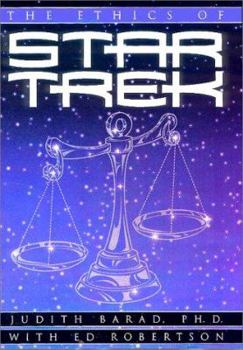
The Ethics of Star Trek

Select Format
Select Condition 
Book Overview
Lwaxana Troi decides to please her Kostolain husband-to-be by wearing a traditional wedding gown at their service, even though her own orthodox Betazoid tradition requires her to go nude. At the last minute, she changes her mind and arrives at the ceremony wearing nothing but a smile. Her fianc is shocked -- so shocked that he cancels the wedding. If you were Lwaxana Troi, what would you have done? Is honoring your own tradition more important than respecting someone else's? Though the world of Star Trek is clearly set in the future, its attitudes, politics, and culture have always reflected the mores of today. Perhaps that's why this phenomenal series has kept us fascinated, challenged, and inspired -- as well as entertained -- for nearly thirty-five years. From the original adventures of Kirk, Spock, and McCoy to the present-day saga of Voyager, Star Trek reminds us that even in the brave new world of the twenty-fourth century, the deepest questions of morality must still be answered. The fundamental principles that have always guided our heroes are indeed powerful enough to provide direction in our own lives. But what exactly are the ethics of Star Trek? Where do they come from? Are these principles always the same from series to series? What do they mean for us today? Using episodes from all four Star Trek series, as well as examples from Plato, Aristotle, Sartre, and other great philosophers of the past, The Ethics of Star Trek explores the answers to these and other important ethical questions: Why is good stronger than evil? If the Prime Directive is so inviolable, why does Kirk always seem to break it? Would Nietzsche have made a good starship captain? What's more important, the intentions behind our actions or the results we get? Does absolute power really corrupt absolutely? What would you do with the power of Q? How would Kant's insistence on autonomous altruism have affected the Federation's dealings with the Borg? Are rational beings the only life-forms entitles to our respect? What would it mean if, deep down, everyone really were a Ferengi? Join Dr. Judith Barad and Ed Robertson as they take the complex, intriguing, and often confusing subject of ethics and make it practical, understandable, and accessible -- for this century and beyond
Format:Hardcover
Language:English
ISBN:0060195304
ISBN13:9780060195304
Release Date:December 2000
Publisher:HarperCollins
Length:384 Pages
Weight:1.28 lbs.
Dimensions:8.3" x 1.2" x 5.5"
Customer Reviews
5 ratings
Lovin the Star Trek Ethics!
Published by Thriftbooks.com User , 17 years ago
This is my second purchase of the book because I made the awful mistake of loaning it to someone who wouldn't give it back. So instead of being so angry I took the advice of the Star Trek Ethics and followed steps to create a perfect union once again. I love the book and think as a person that watches the Star Trek Series/All of Them so much the book is a perfect companion and way to revisit the consciousness and actually live it! "Live Long and Prosper"
A fun read
Published by Thriftbooks.com User , 23 years ago
I enjoyed this book because I didn't take it too seriously. It provides a fun way to pass a few hours while reading about the ethical nature of decisions made by a variety of Star Trek persona. As any Star Trek fan would admit, many episodes contradict one another to the point where it's difficult to pin ethical standards upon the various groups, Klingons, etc. As a result, no matter how enamored with Star Trek you may be, this should not act as a manual for living your life in an ethical fashion. However, it handily explains a variety of ethical principles as outlined by many famous philosophers of human-kind.
To paraphrase Mr. Spock, this book is ?fascinating!?
Published by Thriftbooks.com User , 24 years ago
This book is for everyone who loves Star Trek for more than just its cool special effects, its hot alien babes, or even its sparkling intergalactic political intrigue. In other words, this book is for the serious (or casual) Star Trek fan who loves the show first and foremost because it embodies the ideals of its creator, Gene Roddenberry. And what are those ideals? Well, as the title, "The Ethics of Star Trek," would suggest, for one thing they're highly ETHICAL! But what is meant by the word "ethical" exactly, what does this have to do with Star Trek, and how does it fit in with the major philosophical schools of thought? Interested? Well, then, you've got to read this book!In my opinion, what makes "The Ethics of Star Trek" so effective, more so in many ways than a straight philosophy textbook, is that the authors are able to make philosophy come to life in a fun way without "dumbing it down." How do they do this? Mainly by taking particular episodes and characters from Star Trek over the years, and then subjecting them to a serious philosophical analysis. For instance, the authors examine the actions and thoughts of Commander Benjamin Sisko in the Deep Space Nine episode, "In the Pale Moonlight," to examine utilitarianism ("the greatest good for the greatest number") and existentialism (the "angst" of free choice). Two "Star Trek: The Next Generation" episodes - "Ethics" and "I, Borg" - are used to illustrate the difference between Kant's three kinds of actions (those inconsistent with duty, those in accordance with duty, and those "from" duty). From all this, and much more, we see strains of Aristotelian virtue, Kantian morality, existentialism, and Platonic virtue running throughout the Star Trek series. We also see some basic values expressed: the ends does not always justify the means; rational beings should always be treated as ends in and of themselves; it is important to follow duty over desire, and altruism over egoism; and one must consider both the intentions AND the consequences of an action in evaluating its morality.In sum, "The Ethics of Star Trek" is an enthralling, engaging, entertaining, enlightening book which takes both philosophy and Star Trek seriously. This is a great book for those of us with some knowledge of philosophers like Aristotle, Plato, Immanuel Kant, Jeremy Bentham, John Stuart Mill, and Jean-Paul Sartre, but who could perhaps use a refresher course. "The Ethics of Star Trek" also would be a great primer for those of us who may not remember anything about Scottish philosopher W.D. Ross, and his six categories of prima facie duties, or Tom Regan and his "duty-based ethics," but are interested to learn! "The Ethics of Star Trek" covers the basics of all these philosophers, and more, and then applies them to Star Trek. As Mr. Spock might say, "fascinating!"
Star Trek Stories as Moral Fables Exemplifying a Philosphy
Published by Thriftbooks.com User , 25 years ago
As someone who has watched a lot of Star Trek, I find myself constantly noticing that the "normal" rules often don't quite apply in the various shows. Captain Kirk was always violating the Prime Directive. Starfleet Academy gave Kirk a commendation for breaking into the computer to change the programming of an "impossible" assignment (looks like cheating to me). Spock was always sacrificing himself for the good of the many (or the one, in the case of Captain Pike). Captain Janeway often risked the whole ship to try to help one crew member. On Deep Space Nine, the Federation is involved in maintaining an alien religion. Other cultures get a lot of respect, but the ones that are like the Nazis are opposed. If you are like me, you often feel upside-down, inside-out, and topsy-turvey all at the same time in these stories. What is the right thing to do in the 24th century?Professor Barad teaches Ethics at Indiana State and has a course on the philosophy of Star Trek. That attracted me to the book right there. I never took a philosophy course when I was in college that sounded nearly that interesting. We studied Plato, Aristotle, Kant, Kierkegaard, and symbolic logic. Well, you'll be pleased to know that this volume has plenty of Star Trek, Plato, Aristotle, Kant, and Kierkegaard. But you'll also be relieved to know that at least the symbolic logic is missing!The purpose of this book (its Prime Directive) is to "stimulate greater awareness of the many ethical issues and concerns in daily life." Using famous Star Trek episodes from all four series (The original series, Next Generation, Deep Space 9, and Voyager) as the foundation, classic ethical issues are first examined in terms of the leading sources of ethical thought: such as cultural relativism, religion, Greek and Roman philosophies, the social contract, Kant's notion of duty, utilitarianism, and existentialism. If you are not familiar with all of these, Professor Barad provides just what you need to know. So its meaty, but not heavy.Then Professor Barad considers whether or not all four series are consistent with any of these ideas. Her conclusion seems right when she says that Star Trek has created a new synthesis of Aristotle's idea of the golden mean (too much or too little of any character quality is a vice while the balance in between is a virtue), Kant's idea of operating "from duty," and Kierkegaard's concept of individual freedom and responsibility. The classic Aristotelean virtues are all present: courage; temperance; friendliness; gentleness; cooperation; justice; open-mindedness; compassion; mindfulness; respect for others; honesty; and loyalty. She leaves us with the idea that perhaps we as a society can evolve in this direction and leaves us with a thought from Captain Pickard: "Make it so."What makes these thoughts interesting is that Professor Barad points out that "noble as they are, none of the Star Trek characters are saints." Gene Roddenberry himself seem
Lively, fun introduction to heavy-duty ethical concepts
Published by Thriftbooks.com User , 25 years ago
I used to watch Star Trek, which I believe is an asset when reading this book. But you don't have to be a true aficionado of Star Trek in all its permutations to benefit from -- and enjoy -- this unusual approach to the fascinating subject of ethics. That's because, at the start of each chapter, authors Barad and Robertson describe various individual shows in enough (but never too much) detail so that you can picture the scenes and participate fully in the lively conversation. What's right and what's not? Whose view of ethics was applied by the makers of the show, and which SHOULD be applied in each convoluted instance, Aristotle's or Kant's, Sartre's or the Christians? The tone of the writing is always fresh and conversational, without oversimplifying the topic. Is Spock sometimes "too logical," or is Kirk sometimes too swayed by emotion? How can we tell? By the final results -- the universe is saved yet again -- or by what they hoped would happen? I found myself drawn in again and again, able to follow the thread of what is, after all, a high level discussion. Highly recommended for the casual reader interested in how we determine what to do in living a "good" life. I'd love to see this used in high schools and colleges to introduce people to these age-old but always fresh ideas in a compelling way.
Copyright © 2026 Thriftbooks.com Terms of Use
| Privacy Policy | Do Not
Sell/Share My Personal Information | Cookie Policy | Cookie Preferences | Accessibility Statement
ThriftBooks® and the ThriftBooks® logo are registered trademarks of Thrift Books Global, LLC
ThriftBooks® and the ThriftBooks® logo are registered trademarks of Thrift Books Global, LLC
