
Skip to content
Scan a barcode
Scan
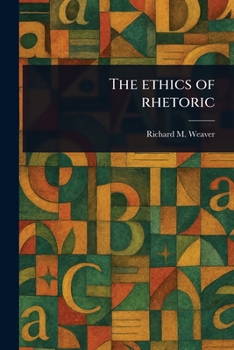
Paperback The Ethics of Rhetoric Book

ISBN: 1023547325

ISBN13: 9781023547321

The Ethics of Rhetoric

Select Format

Select Condition ThriftBooks Help Icon

Recommended

Format: Paperback

Condition: New

$20.96
Ships within 2-3 days
Save to List

Book Overview

Explore the profound connection between ethics and persuasion in Richard M. Weaver's seminal work, "The Ethics of Rhetoric." This enduring study delves into the moral implications of argumentation, examining how rhetoric shapes not only our discourse but also our values. Weaver argues that rhetoric is not merely a tool for persuasion but a reflection of our ethical commitments, impacting the very fabric of society.

A cornerstone of philosophical thought, this work investigates the ethical responsibilities inherent in persuasive communication. It bridges the disciplines of rhetoric, ethics, and moral philosophy, offering insights into the enduring power of language to influence belief and action. Discover the timeless relevance of Weaver's analysis as he explores the moral dimensions of argumentation, providing a framework for understanding the ethical considerations that underpin all forms of communication. This meticulously prepared print edition makes this classic text accessible to all those interested in the art and ethics of persuasion.

This work has been selected by scholars as being culturally important, and is part of the knowledge base of civilization as we know it.

This work is in the public domain in the United States of America, and possibly other nations. Within the United States, you may freely copy and distribute this work, as no entity (individual or corporate) has a copyright on the body of the work.

Scholars believe, and we concur, that this work is important enough to be preserved, reproduced, and made generally available to the public. We appreciate your support of the preservation process, and thank you for being an important part of keeping this knowledge alive and relevant.

Customer Reviews

2 ratings

Well Worth The Investment

Weaver's writing have inspired me over the years in many ways. One cannot read his work without aspiring to a more noble manner of life as well as aim for it. In this work, one is inspired toward the goal of eloquence in the pursuit of persuasion. Unlike a previous reviewer, I found Weaver's handling of Burke and Lincoln to be even handed. His analysis of their rhetoric cannot be entirely divorced from his own inclinations and I do not fault him for that. Like the first essay on the Phaedrus, Weaver does not accept the role of non-lover in his own rhetoric nor desire it of others. What Weaver does very well is open our eyes to what ought to be self-evident - that the manner of our argumentation, the style of our attempt to persuade, reveals much about ourselves and the "ethic" of our rhetoric. As such, at least with me, it forces us to re-examine that which indeed we do hold dear and what our objectives truly are. In a world where most people confess principle yet argue from circumstance, knowing the difference between the two enables us to avoid hypocrisy in ourselves and at the same time, understand the filters which govern other's hearing. Along the way, Weaver's examples, particularly his analysis of the Scope trials, awakens us to how rhetoric can function and how, just perhaps, a reawakening to it in in our culture, might immensely elevate the consciousness of our tribes. If the ethics of it were more widely regarded, the great issues of our day might indeed be discussed in a more compelling and enlightening manner.

An Unacknowledged Masterpiece

Except for the final entry in this masterly collection of essays, "Ultimate Terms in Contemporary Rhetoric," which has been widely reprinted in anthologies, the contributions of Weaver, a late professor of rhetoric at the University of Chicago, are not generally known. Yet at his best, Weaver's essays bear comparison with those of his favorite George Orwell. Like Orwell, Weaver was one of the truest humanists of our age and hence really cannot be accurately described with our labels of left-wing, centrist, or right-wing. Exposing the vicious or stupid to champion the humanly valuable was his forte; having a seemingly unerring sensibility for doing this, Weaver is always able to surprise his readers, forcing them to hold little dialectics with themselves to discover their ultimate beliefs and terms of persuasion. Whether he is restoring to a central place in the educational experience and in political speech the role of Eros, or explaining why Edmund Burke was a liberal but Abraham Lincoln a conservative, Weaver is always both a shock and a joy to read.
Copyright © 2026 Thriftbooks.com Terms of Use | Privacy Policy | Do Not Sell/Share My Personal Information | Cookie Policy | Cookie Preferences | Accessibility Statement
ThriftBooks® and the ThriftBooks® logo are registered trademarks of Thrift Books Global, LLC

GoDaddy Verified and Secured