


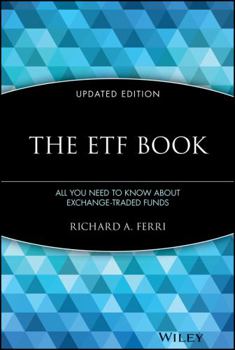
The Etf Book: All You Need to Know about Exchange-Traded Funds


Select Format
Select Condition 
Book Overview
Exchange-traded funds (ETFs) are revolutionizing the investment industry. From their introduction in 1993, ETFs have expanded exponentially over the past fifteen years. You, as an informed investor, need to know what makes ETFs unique, how they work, and which funds may help you achieve your financial goals. The updated edition provides the most current look at the ETF market, where the number of funds has doubled since the book first published in December 2007. A huge number of bonds funds, commodities funds, currency funds, leverage and short funds have been introduced. In addition, actively managed ETFs are here now, and some major mutual fund companies, like Fidelity and PIMCO, are getting into the market. Remarkably, the terminology in the ETP marketplace is also evolving at a rapid pace. The acronym ETP for exchange-traded product has become an industry standard. The term did not exist two years ago.
Written by veteran financial professional and experienced author Richard Ferri, The ETF Book, Updated Edition gives you a broad and deep understanding of this important investment vehicle and provides you with the tools needed to successfully integrate exchange-traded funds into any portfolio.
This detailed, yet clearly articulated guide contains the most up-to-date information on navigating the growing number of ETFs available in today's marketplace. Divided into four comprehensive parts, this guide addresses everything from ETF basics and in-depth fund analysis to the tax benefits of using ETFs. Included are a variety of portfolio management strategies using ETFs and examples of different model portfolios that you can easily adapt to your own investment endeavors.
Whether you're just getting started or are a seasoned ETF investor, The ETF Book, Updated Edition will help enhance your understanding of this evolving field by: Examining the fundamental differences between exchange-traded portfolios Highlighting how to effectively implement a wide selection of ETFs?from Exploring specific ETF strategies?from buy and hold to market timing and sector rotation Introducing Index Strategy Boxes?a new way to understand index construction and how a fund is investing your money And much more Each chapter of The ETF Book, Updated Edition offers concise coverage of various issues. It is filled with in-depth insights on different types of ETFs and practical advice on how to select and manage them. The appendixes are an added benefit, offering an ETF Resource List, which will point you to more places for information on these structures, and a detailed Glossary to help you with industry-specific definitions.
The ETF Book, Updated Edition is an invaluable road map for developing a winning investment strategy. Armed with the knowledge found throughout these pages, you'll be prepared to build a solid portfolio of ETFs that will benefit you for years to come.
Written by veteran financial professional and experienced author Richard Ferri, The ETF Book, Updated Edition gives you a broad and deep understanding of this important investment vehicle and provides you with the tools needed to successfully integrate exchange-traded funds into any portfolio.
This detailed, yet clearly articulated guide contains the most up-to-date information on navigating the growing number of ETFs available in today's marketplace. Divided into four comprehensive parts, this guide addresses everything from ETF basics and in-depth fund analysis to the tax benefits of using ETFs. Included are a variety of portfolio management strategies using ETFs and examples of different model portfolios that you can easily adapt to your own investment endeavors.
Whether you're just getting started or are a seasoned ETF investor, The ETF Book, Updated Edition will help enhance your understanding of this evolving field by: Examining the fundamental differences between exchange-traded portfolios Highlighting how to effectively implement a wide selection of ETFs?from Exploring specific ETF strategies?from buy and hold to market timing and sector rotation Introducing Index Strategy Boxes?a new way to understand index construction and how a fund is investing your money And much more Each chapter of The ETF Book, Updated Edition offers concise coverage of various issues. It is filled with in-depth insights on different types of ETFs and practical advice on how to select and manage them. The appendixes are an added benefit, offering an ETF Resource List, which will point you to more places for information on these structures, and a detailed Glossary to help you with industry-specific definitions.
The ETF Book, Updated Edition is an invaluable road map for developing a winning investment strategy. Armed with the knowledge found throughout these pages, you'll be prepared to build a solid portfolio of ETFs that will benefit you for years to come.
Format:Hardcover
Language:English
ISBN:0470537469
ISBN13:9780470537466
Release Date:August 2009
Publisher:Wiley
Length:400 Pages
Weight:1.38 lbs.
Dimensions:1.3" x 6.3" x 9.2"
Customer Reviews
4 ratings
The Definitive ETF Guide!
Published by Thriftbooks.com User , 18 years ago
The ETF Book: All You Need to Know About Exchange-Traded Funds I have been a long-term fan of low-cost, passive investing (i.e. index funds) and have read all of Mr. Ferri's books. Recently, I have begun using ETFs in place of index funds. Mr. Ferri's book is a well-researched, complete guide to ETFs. I believe it will be viewed as the definitive ETF book because of its wide-ranging coverage of everything from how ETFs can be used in a portfolio to details of ETF construction. The practical tips (e.g. don't trade an ETF at the beginning or end of a trading day) alone are worth the price of the book. Also, I really like the detailed information on how various ETFs (e.g. gold ETFs) are constructed. Great resource for individual investors as well as for professionals!
An excellent book for the ETF investor
Published by Thriftbooks.com User , 18 years ago
I love ETF investing. This book is a must-read if you're interested in investing in ETFs. You'll no doubt want to read other books too. But this is the cornerstone of the library of the ETF investor. The book is well written and arranged nicely. It's a good read and a great reference. It gives you some sample life cycle investing portfolios, which I find most useful. You'll find the benefits and the drawbacks of ETF investing. You'll learn about the different types of ETFs. You'll also learn about the different management styles available. I would have liked more information on fixed income investing. I find there's not much available on that. I also find there isn't anything about defensive investing, which we need right now. There is help with asset allocation but I suspect you'll want to buy a book that devotes itself entirely to that subject. I keep the book near my left hand as I readjust my portfolio and when I'm considering a fund. I highly recommend this great book.
The ETF Book
Published by Thriftbooks.com User , 18 years ago
Let me say at the outset that I am NOT a professional investor, that I HAVE invested in individual securities as well as mutual funds for forty years, that I now, as a retiree, restrict myself to annuity income and mutual fund investments (mostly passive), and that I have not yet purchased ETFs, though Ferri's book convinces me ETFs could perform a useful function in my portfolio. If, like me, you have not yet invested in ETFs but want to know how they are constructed, how they function, and what role they might serve in your portfolio, then Rick Ferri's book is the FIRST place you should go for a comprehensive guide to understanding ETFs. Ferri's book can be read in, or through depending on the reader's interests. By this I mean his book divides into four free-standing, but continuous, parts. The first part deals with ETF Basics--the history, mechanics, and potential benefits and drawbacks. Part Two, a real eye-opener for this reader, focuses on index construction and provides an index strategy box akin to how Morningstar analyses mutual funds. Part Three broadens the discussion to styles and choices--from broad domestic/global indexes to equivalents of slice and dice strategies. Part Four shows, in detail, how investors can incorporate ETFs into their asset allocation plan--whether they are inclined to passive, active, or a combination of portfolio strategies. Thankfully, Rick Ferri goes to great pains to communicate clearly with his readers. To my mind, he has no axe to grind, although as a professional portfolio manager he advocates passive investing. Ferri provides many alternative portfolios (passive, active, combo) spread along a continuum of life-cycle investing. It certainly speaks well of this fine book that it receives the ringing endorsements of the likes of Don Phillips, David Blitzer, and Anthony Rochte, Senior Managing Director of State Street Global Advisors. Robert Uphaus
Excellent Educational book on ETFs
Published by Thriftbooks.com User , 18 years ago
A super book by Rick Ferri. The book goes into the nitty gritty of ETFs and the different types of composition. The information is well written so someone with a just a basic knowledge of investments can understand. Too many investment books written these days are just full of marketing hoola and are useless. This book could be used in a college class with the detail of information presented.
Copyright © 2026 Thriftbooks.com Terms of Use
| Privacy Policy | Do Not
Sell/Share My Personal Information | Cookie Policy | Cookie Preferences | Accessibility Statement
ThriftBooks® and the ThriftBooks® logo are registered trademarks of Thrift Books Global, LLC
ThriftBooks® and the ThriftBooks® logo are registered trademarks of Thrift Books Global, LLC
