


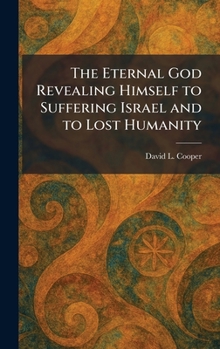
The Eternal God Revealing Himself to Suffering Israel and to Lost Humanity

Select Format
Select Condition 
Book Overview
"The Eternal God Revealing Himself to Suffering Israel and to Lost Humanity" is an insightful theological study that seeks to explore the nature of divine revelation and the relationship between the Creator and His creation. Authored by the noted biblical scholar David L. Cooper, this work examines the scriptural foundations of God's interaction with the nation of Israel throughout history and His ultimate message of salvation to the world.
The text focuses on the themes of suffering and redemption, providing a detailed analysis of how the Eternal God makes Himself known through prophecy, law, and grace. Cooper bridges the gap between the promises made to the patriarchs and the universal hope offered to all humanity, presenting a cohesive vision of the biblical narrative. The book is particularly notable for its emphasis on the historical and spiritual significance of Israel's role in the divine plan.
As a significant piece of early 20th-century religious scholarship, this work offers readers a window into the development of Messianic and dispensationalist thought. It remains a valuable resource for students of theology and biblical studies, providing a clear and reasoned defense of the continuity of God's redemptive work across the ages.
This work has been selected by scholars as being culturally important, and is part of the knowledge base of civilization as we know it. This work was reproduced from the original artifact, and remains as true to the original work as possible. Therefore, you may see the original copyright references, library stamps (as most of these works have been housed in our most important libraries around the world), and other notations in the work.
This work is in the public domain in the United States of America, and possibly other nations. Within the United States, you may freely copy and distribute this work, as no entity (individual or corporate) has a copyright on the body of the work.
As a reproduction of a historical artifact, this work may contain missing or blurred pages, poor pictures, errant marks, etc. Scholars believe, and we concur, that this work is important enough to be preserved, reproduced, and made generally available to the public. We appreciate your support of the preservation process, and thank you for being an important part of keeping this knowledge alive and relevant.
Customer Reviews
ThriftBooks ® and the ThriftBooks ® logo are registered trademarks of Thrift Books Global, LLC
