
Skip to content
Scan a barcode
Scan
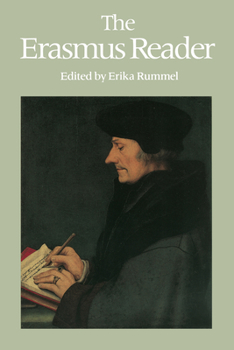
Paperback The Erasmus Reader Book

ISBN: 0802068065

ISBN13: 9780802068064

The Erasmus Reader

'A judicious and discerning selection of large extracts from the Collected Works of Erasmus ... thoughtfully designed to include major statements of Erasmus on civility in individual morals, humanistic study and education, the Christian life, reform of the church, and the peaceful constraint of political force. It is to my mind the most comprehensive and penetrating anthology of Erasmus' writing, forcefully revealing his central values.' - Charles Trinkaus, Emeritus Professor of History, University of Michigan


'Rummel's collection makes available readable translations of Erasmus' most original and influential works - the books that made him the intellectual conscience of his generation of scholars and the inspiration of many Reformers who took positions he did not accept. They reveal the biblical scholar, the humanist and literary theorist, and the social critic that Erasmus was, far more fully and vividly than any previous anthology.' - Anthony Grafton, Program in History of Science, Princeton University


'The high quality of the Toronto edition of the Collected Works of Erasmus has earned it a central place in the libraries of scholars around the world. The Erasmus Reader extends this impact to the carrels and desks of beginning and advanced students of Renaissance and Reformation history.' - Heiko A. Oberman, Director, Division for Late Medieval and Reformation Studies, University of Arizona

Recommended

Format: Paperback

Condition: Very Good*

*Best Available: (ex-library)

$17.19
Save $30.76!
List Price $47.95
Almost Gone, Only 1 Left!
Save to List

Customer Reviews

2 ratings

The Renaissance Scholar and a Founding Father of Modern Europe

The editor's stated goal is to introduce readers to a broad range of representative samples of Erasmus' work, focussing on education, ethics, politics and social criticism. Works requiring specialised knowledge, such as his biblical exegesis, are not included. Each text is preceded by a short introduction from the editor regarding the context. The writings of Erasmus are a great pleasure to read and an essential part of European culture. The book is sufficient for beginners because it includes a short introduction from the editor as well as two introductions written by Erasmus himself, a short resumé of his life and a lengthy catalogue and defence of his writings. The book has a beautiful cover and the formatting is reader-friendly. I recommend this book, assuming that there are no substantially better anthologies out there. I have only two criticisms. First, the text has a number of typographical errors - surprising for a third edition. Second, the footnotes are often barren of explanation. Some are helpful but most are succinct references to the complete works of Erasmus or other books. Granted how much could have been explained, the sparse footnotes are a disservice to the reader, especially to students. The remainder of this review consists of notes about the man and some quotes. Erasmus (born circa 1469, died 1536) was an unusually gifted man, perhaps the most gifted master of classical Latin and Greek, who led an unusually peripatetic life and thereby spread Christian Humanism across Europe during the Renaissance. He knew Italy well, where the Renaissance first exploded and where the Church had become a mockery of its professed values. He was a thinker and a poet and was happy never to have been a leader. He addressed his writings to scholars. He wrote profoundly and copiously. Among his many themes was his constant criticism of contemporary Christianity having little to do with the original Christ and his teachings. His books were reprinted many, many times. Perhaps Erasmus was the first living author to become a "media superstar" thanks to the relatively new printing press. By the 1530's, the writings of Erasmus accounted for 10 to 20 percent of all book sales. He was hugely influential. He honestly and openly criticised the Church and society, but always with a sense of loyalty. He was careful to maintain his support among powerful people (including popes and cardinals). He was proud to have avoided criticising anyone by name, but by the age of 50 he was forced to do so to defend himself. He wrote new Latin and Greek versions of the New Testament including important corrections to earlier standard works. Scholastics had great difficulty comprehending how their beloved old texts were so clearly shown to be flawed. His critiques were taken up by Reformists, forcing Erasmus to be a lone voice calling for moderation between the thoroughly corrupt Church and the increasingly radical Reformation. Erasmus correctly foresaw the great lakes of

An Impressive Intellect

In this volume a reader can take in Erasmus as he tackles questions ranging from warfare between Christian kingdoms to the place of classical rhetoric in Christian education to what to do when one must break wind at a banquet table. Each essay has Erasmus's gentle, deliberative touch, and Rummel's translation of "In Praise of Folly" is the best that I've encountered. The book's binding has held up for nearly ten years now, and Rummel's translations convey a smoothness and learned style that make each of the great humanist's pieces a joy to read. These short pieces have become welcome respites to enjoy in my own breaks from the ardor of Calvin and the fury of Milton.
Copyright © 2026 Thriftbooks.com Terms of Use | Privacy Policy | Do Not Sell/Share My Personal Information | Cookie Policy | Cookie Preferences | Accessibility Statement
ThriftBooks® and the ThriftBooks® logo are registered trademarks of Thrift Books Global, LLC

GoDaddy Verified and Secured