


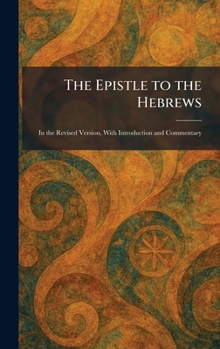
The Epistle to the Hebrews: In the Revised Version, With Introduction and Commentary

"The Epistle to the Hebrews" stands as one of the most profound and architecturally sophisticated books within the New Testament, offering a unique theological bridge between Old Testament traditions and the revelation of Christ. This volume presents the text in the "Revised Version," accompanied by an extensive introduction and a scholarly commentary designed to clarify the intricate arguments and historical context of the letter.
The work explores the central themes of the epistle, including the high priesthood of Jesus, the nature of faith, and the superiority of the new covenant over the old. The introduction provides essential background on the authorship, date, and purpose of the letter, addressing the many questions that have long fascinated biblical scholars. The commentary portion offers verse-by-verse insights, helping readers navigate the rich symbolism and exhortations that characterize this influential scripture.
Ideal for students of theology, clergy, and lay readers alike, this study provides a rigorous yet accessible examination of the text. By focusing on the linguistic and historical nuances of the "Revised Version," the commentary illuminates the enduring spiritual and literary significance of a book that continues to shape Christian thought and practice.
This work has been selected by scholars as being culturally important, and is part of the knowledge base of civilization as we know it. This work was reproduced from the original artifact, and remains as true to the original work as possible. Therefore, you may see the original copyright references, library stamps (as most of these works have been housed in our most important libraries around the world), and other notations in the work.
This work is in the public domain in the United States of America, and possibly other nations. Within the United States, you may freely copy and distribute this work, as no entity (individual or corporate) has a copyright on the body of the work.
As a reproduction of a historical artifact, this work may contain missing or blurred pages, poor pictures, errant marks, etc. Scholars believe, and we concur, that this work is important enough to be preserved, reproduced, and made generally available to the public. We appreciate your support of the preservation process, and thank you for being an important part of keeping this knowledge alive and relevant.
Customer Reviews
ThriftBooks ® and the ThriftBooks ® logo are registered trademarks of Thrift Books Global, LLC
