


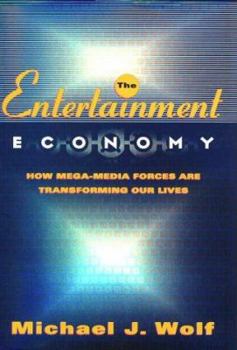
The Entertainment Economy: How Mega-Media Forces Are Transforming Our Lives

Select Format
Select Condition 
Book Overview
Every so often an author explains our culture in such a new and original way that from that day on we see the world around us in a new light. From Understanding Media by Marshall McLuhan through... This description may be from another edition of this product.
Format:Hardcover
Language:English
ISBN:0812930428
ISBN13:9780812930429
Release Date:March 1999
Publisher:Crown Publishing Group, The
Length:336 Pages
Weight:1.36 lbs.
Dimensions:1.1" x 6.4" x 9.5"
Related Subjects
Arts, Music & Photography Business Business & Investing Communication & Media Studies Communications Consulting Hospitality, Travel & Tourism Industries & Professions Management & Leadership Performing Arts Politics & Social Sciences Popular Economics Skills Social Science Social Sciences Sports & Entertainment Systems & PlanningCustomer Reviews
5 ratings
Unique and Compelling Perspectives
Published by Thriftbooks.com User , 25 years ago
According to Michael J. Wolf, "Locally, globally, internationally, we are living in an entertainment economy." In fact, that is the title of his new book which consists of ten chapters which proceed from an introduction to the "entertainment zone" to a "view from tomorrow." In between, Wolf carefully examines a full-range of business situations in which entertainment plays an increasingly more important role. For example, he focuses on the fun-focused customer, the e-factor ("there's no business without show business"), the battle for attention, the struggle for world domination, the genesis of a phenomenon (ie whatever redefines "success"), what he calls "enteractivity", brand empires, and the role of sponsors.Wolf observes that "Within its home turf....entertainment is in many parts of the world the fastest-growing sector of the economy. This is as true of developing countries as it is of mature ones. But of even wider impact is the way entertainment content has become a key differentiator in virtually every aspect of the broader consumer economy." Moreover, "...where America's entertainment economy goes, the rest of the world is not far behind." Although he does not state it explicitly, Wolf views "entertainment" from two quite separate perspectives: entertainment as a commodity (films, videos, radio and television, concerts, athletic events, etc.) and entertainment as a strategy (eg to create a sense of being "entertained"). As Wolf explains, not all commodities are inherently entertaining but it is possible to nourish the appeal of virtually all commodities by use of appropriate entertainment principles. In this respect, Wolf seems to agree with Schmitt & Simonson, co-authors of Marketing Aesthetics. Consider Williams-Sonoma which attracts customers to its upscale stores with the aromas of fresh-baked bread and fresh-brewed coffee, produced on-site by appliances it sells. Schmitt & Simonson assert that marketing is most effective when it appeals to most (if not all) of the five senses. Wolf would no doubt confirm that the nature and extent of that appeal will usually determine the nature and extent of a consumer's sense of being "entertained." Every retail merchandiser should ask, "Who buys what we sell? Which images will be most appealing? Window displays, posters, counter-top promotions? Which aromas will be most appealing? Gourmet coffee, popcorn, chestnuts roasting on an open fire? Which sounds will be most appealing? Bach, Hole, Dwight Yoakam, Celine Dion?"Wolf characterizes Ted Turner, Michael Eisner, Sumner Redstone, and Rupert Murdoch as "the conquistadors of modern business." Why? Because they and their associates understand so well that entertainment (both as a commodity and as an influence) has an almost unlimited global audience. To Wolf's credit, everything he says is directly relevant to almost any organization, regardless of size of nature. If an organization does not understand The Entertainment Economy, it probably do
CHANGES IN OUR LIVES CHANGE THE ENTERTAINMENT BUSINESS
Published by Thriftbooks.com User , 26 years ago
This book is an entertaining read -- as any book on this subject should be. It is hip, fast-paced, and easy to follow -- like clips from MTV. I think the fundamental premise is wrong, however. Mr. Wolf feels that entertainment is changing our lives. It looks to me like it is the other way around. The rapid proliferation of technology and irresistible forces in the economy mean that the stress level Is higher than ever, people are trying harder, and need to be entertained in briefer, more satisfying doses. The book makes this point very well, but chooses to draw the opposite conclusion. If families had had nice theme parks to go to before Disneyland, then Disneyland would not have been such a big draw. Broadcasters could have raised prices a lot when they had the big market before cable took off. They were too myopic to do so. Until the Internet, entertainment was usually reactive rather than proactive. Look how long it took Las Vegas to discover entertainment other than gambling and risque shows. The key point of this book for everyone is that we are in for an unprecedented boom in the value of the talent that provides good entertainment. This is caused by the fragmentation of the audience and channels of distribution. As a result, the good will look much better than ever amidst the increasing masses of the bad. A larger audience will want to spend money on the same things, creating a bonanza. Thinking through how to apply that lesson to your own business is a valuable question. Great entertainment values will be more useful than ever, and bad ones will be less successful than ever. Unless you can be great, don't bother seems to be the message. Mr. Wolf has probably helped us all to overcome our misconceptions that entertainment is only for those in the "entertainment" business. Entertainment skills, properly-applied, can become a powerful force for any business. What this book lacks is specific direction on how to apply this insight. My suggestion is that you apply an eight-step process. First, learn to understand by measuring what is entertaining and what is not about your business. Second, then begin to measure how entertainment is effectively helping or not in your key activities. Third, measure the current best practices in this area and estimate where the future best practice will be in 5 years. Fourth, surpass the future best practice by combining existing best practices in new ways that are unlikely to be duplicated by others. Fifth, estimate the ideal best practice (the sort of simultaneous marriage of business and entertainment that transforms both forever) by looking to other areas of human activity where is occurs. A good example may be the effectiveness of sincere efforts to solve terrible problems (like Johnson & Johnson and the tainted Tylenol capsules, and the work site experiences of Habitat for Humanity). Sixth, seek to approach the ideal best practice. Seventh, find the right people, r
A Handbook For Artists in the New Economy
Published by Thriftbooks.com User , 26 years ago
It is the best of books, it is the worst of books. But for those of you interested in becoming self-supporting, even wealthy, beloved and famous artists, ignore Michael Wolf's book, The Entertainment Economy, at your own risk. The only thing really shocking about this book is that it sets down in cold, facile language the rules of getting your product into the raging currents of the media deluge. At first glance it is a discouraging read for those who still harbor thoughts about the sanctity of artistic expression. Look a little deeper, though, and realize that what this mega-media consultant has given you is the keys to the kingdom. Instead of thinking of yourself as another lonely writer, filmmaker, or singer at the mercy of a hostile media universe, change your self-concept to that of an AEO, or Artist-Executive Officer, of your own entertainment corporation. Because the bottom line to people like Wolf and the media clients he serves is money, market share and mo' money.From this vantage point, which has you thinking tactically about the business of finding an audience, as well as strategically about the nature of your expression, Wolf's book can serve as a manual in how to breach the citadel of entertainment corporations who control your ability to achieve your objective. As Sun-Tzu said, "It is only one who is thoroughly acquainted with the evils of war that can thoroughly understand the profitable way of carrying it on, " and in this vein I offer ten maxims gleaned from Wolf's book which describe the objectives, operations and thought processes of the enemy: Maxim I: There are rules to the game, learn them. Does it make any sense to spend your whole life developing your artistic expression to lose the opportunity at the final gate because you are ignorant of certain entertainment business fundamentals? The concept of the AEO, or Artist-Executive Officer, is a hybrid - in today's media environment you have to develop your craft and understand the rules of business if you want your work to reach an audience. There is an upside to subjecting yourself to learning the rigors of dollars and sense business considerations - it quickly rubs off any juvenile shine your work may have to it. Maxim II: You are competing against everything else. Everything. From an entertainment executives point of view, every product in the media multi-verse is simultaneously competing with everything else out there - not for honor or recognition, but for market share and consumer dollars. There is no such thing as an isolated medium, so your product has got to stand up to universal expectations of production and entertainment value no matter what medium you are working in. Maxim III: Your product must fulfill the audience need to be entertained. Having so many entertainment choices available to us at any given moment and so little time in which to enjoy them, Wolf says, has the effect of, ". . . upping the ante for eac
Be More Entertaining and You'll Get the Business
Published by Thriftbooks.com User , 27 years ago
This fascinating, easy-to-read book is built around a simple and compelling message, entertainment is a key differentiating element in making business services and products more successful. Everything is becoming more experience than product or service. The Entertainment Economy reminds me of a great story from The 2,000 Percent Solution. Coca-Cola tried to replace its original product with an improved taste formula, but consumers did not associate their happy memories with the taste of the new, improved product and rebelled. Classic Coca-Cola was back soon. Experience was more important than optimal taste. I also think you will enjoy working in your business better after you add an entertainment element, so will your employees, and your suppliers. Pretty soon, you'll be having a ball. You will also have a ball when you read this brightly-written book. I recommend that you read In Pursuit of Prime, also.
Hooray for Hollywood and Michael J. Wolf.
Published by Thriftbooks.com User , 27 years ago
I knew it! My kids are choosing their fast food menus based on the current movie tie-in. My tennis shoes have Internet addresses on them. I'm actually buying products I don't need because the commercials have some of my favorite songs as their themes. At least ten companies are claiming to be the #1 entertainment web site (and they all have direct links to Pamela Lee Anderson's video). Plus, my "New York Times" has color, and my "Wall Street Journal" has photographs. There's no mystery about what's next. It's all in THE ENTERTAINMENT ECONOMY, the new book by Michael J. Wolf. This guy presents a fascinating picture of how entertainment and business have morphed. All the book needs is its own jingle...Hooray for Hollywood.
Copyright © 2026 Thriftbooks.com
Terms of Use | Privacy Policy | Do Not Sell/Share My Personal Information | Cookie Policy | Cookie Preferences | Accessibility Statement
ThriftBooks ® and the ThriftBooks ® logo are registered trademarks of Thrift Books Global, LLC
ThriftBooks ® and the ThriftBooks ® logo are registered trademarks of Thrift Books Global, LLC
