


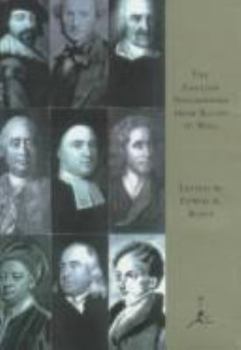
The English Philosophers from Bacon to Mill, (The Modern Library)

Select Format
Select Condition 
Book Overview
The thirteen essays in this Modern Library edition comprise a complete survey of the golden age of English philosophy. The anthology begins in the early seventeenth century with Francis Bacon's... This description may be from another edition of this product.
Format:Hardcover
Language:English
ISBN:0679601317
ISBN13:9780679601319
Release Date:December 1994
Publisher:Modern Library
Length:1088 Pages
Weight:2.32 lbs.
Dimensions:8.3" x 1.8" x 5.8"
Customer Reviews
1 rating
A good survey
Published by Thriftbooks.com User , 22 years ago
The volume 'The English Philosophers: from Bacon to Mill', edited by Edwin A. Burtt, together with its companion volume from the Modern Library, 'The European Philosophers: from Descartes to Nietzsche', edited by Monroe C. Beardsley, provides a good basic collection of the major philosophical writings of the post-Renaissance to the immediate pre-Modern period -- in essence, that period that many people think of as being 'our cultural history' in intellectual terms. The text on the English Philosophers includes many of the major philosophers from the late sixteenth century to the nineteenth century. Each of the philosophers is introduced with a brief one-to-two page biography, but by and large the editor allows the philosophers' own writings to speak for themselves. Where possible, Burtt has opted to include whole texts -- the only exceptions to this are the 'Leviathan' by Hobbes, the 'Essay concerning Human Understanding' by Locke, and 'Principles of Morals and Legislation' by Bentham, owing to their great length; however, even here the selections are much more generous than the typical survey would be.This survey shows the breadth of thinking that concerned the English philosophers -- political philosophy was often near the top of considerations, from Hobbes and Locke in the seventeenth century to Bentham and Mill in the late eighteenth/nineteenth century. Epistemology and metaphysics was similarly a consistent strand, from Bacon's 'Great Instauration' through Berkeley and Hume. Burtt's essay of introduction is an interesting discussion of the development of English philosophy, and some of the key differences English philosophy has from its continental counterpart. Burtt traces a 'national' difference between the philosophical approaches of the Greeks and the Romans, and draws parallels to the situation between the Germans, likened to the Greeks, more interested in the theoretical and speculative, and the English, more akin to the Romans, looking for pragmatic and practical philosophy. (Not ignoring the French, Burtt states that they are more of a synthesis of these two styles, and thus do not stand in sharp contrast to either.) Burtt also draws in the political realities that helped to shape the overall direction of English philosophy. This is not a book about philosophy as much as it is a book of philosophy -- there are few guides or notes or explanatory pieces here, save the actual texts themselves from the major philosophers. Both volumes from the Modern Library are worthy of a place on the shelf of anyone with an interest in politics, philosophy, or the history of ideas.
Copyright © 2026 Thriftbooks.com Terms of Use
| Privacy Policy | Do Not
Sell/Share My Personal Information | Cookie Policy | Cookie Preferences | Accessibility Statement
ThriftBooks® and the ThriftBooks® logo are registered trademarks of Thrift Books Global, LLC
ThriftBooks® and the ThriftBooks® logo are registered trademarks of Thrift Books Global, LLC
