


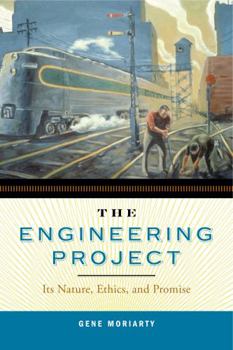
The Engineering Project: Its Nature, Ethics, and Promise


Select Format
Select Condition 
Book Overview
We all live our daily lives surrounded by the products of technology that make what we do simpler, faster, and more efficient. These are benefits we often just take for granted. But at the same time, as these products disburden us of unwanted tasks that consumed much time and effort in earlier eras, many of them also leave us more disengaged from our natural and even human surroundings. It is the task of what Gene Moriarty calls focal engineering to create products that will achieve a balance between disburdenment and engagement: "How much disburdenment will be appropriate while still permitting an engagement that enriches one's life, elevates the spirit, and calls forth a good life in a convivial society?" One of his examples of a focally engineered structure is the Golden Gate Bridge, which "draws people to it, enlivens and elevates the human spirit, and resonates with the world of its congenial setting. Humans, bridge, and world are in tune." These values of engagement, enlivenment, and resonance are key to the normative approach Moriarty brings to the profession of engineering, which traditionally has focused mainly on technical measures of evaluation such as efficiency, productivity, objectivity, and precision. These measures, while important, look at the engineered product in a local and limited sense. But "from a broader perspective, what is locally benign may present serious moral problems," undermining "social justice, environmental sustainability, and health and safety of affected parties." It is this broader perspective that is championed by focal engineering, the subject of Part III of the book, which Moriarty contrasts with "modern" engineering in Part I and "pre-modern" engineering in Part II.
Format:Hardcover
Language:English
ISBN:0271032545
ISBN13:9780271032542
Release Date:March 2008
Publisher:Penn State University Press
Length:224 Pages
Weight:1.05 lbs.
Dimensions:0.8" x 6.5" x 9.2"
Customer Reviews
1 rating
Getting the ratio right
Published by Thriftbooks.com User , 16 years ago
According to Moriarty, technology is promising. Those who thought that engineering is building stuff learn that actually it is "the practice of making good on the promise of technology" (1). Some technology disburdens but disengages. Some technology colonizes without contextualizing. The trick, "focal engineering" is to get the right proportion of each. But how? Usually the subject of getting the proportions of values right is called ethics, a branch of philosophy. Philosophy is argumentative. What is right is what has the best arguments behind it. These days there is no true and complete picture of the way the world is (Putnam). One wonders whether Moriarty thinks he has a true and complete picture of what resonates with the lifeworld. For example, there is no question for him that the golden gate bridge simply resonates. (I for one had never thought about the bridge--so how can it resonate for me?). Much goes unanswered in Moriarty. Moriarty is obviously concerned with the relationship between ethics and engineering. But, what is this relationship? He offers too many candidates. At one point it looks like he favors environmental sustainability, social justice, and safety as obvious and incontrovertible values in themselves. Kant, utilitarianism and the like are useful heuristic tools brought out to assist in applying the fundamental values. But, later, the book appeals to virtue ethics and Hegelian ethics. Will Moriarty's real ethical position please stand up? I am not very fond of creative definitions of terms. I think that philosophy should be above all clear. It should make arguments clear. There is no need to couch them within terminology and phraseology. It is difficult to see how the book coheres. For example, why does it talk about the history of engineering? What does the history of engineering have to do with focal engineering? What does ethics have to do with focal engineering? What is the lifeworld anyway? (as opposed to the deadworld?) I recommend this book as a valiant attempt by a contemporary engineer to bring Borgmann, Hegel and others to bear on current professional ethics. It is an ambitious attempt, but unfortunately, I believe it falls short of being finished or even that functional as a textbook. It may violate its own promises.
Copyright © 2026 Thriftbooks.com Terms of Use
| Privacy Policy | Do Not
Sell/Share My Personal Information | Cookie Policy | Cookie Preferences | Accessibility Statement
ThriftBooks® and the ThriftBooks® logo are registered trademarks of Thrift Books Global, LLC
ThriftBooks® and the ThriftBooks® logo are registered trademarks of Thrift Books Global, LLC
