


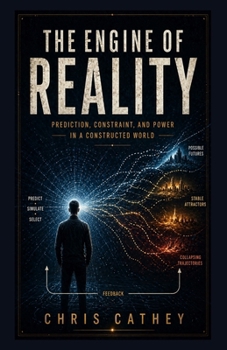
The Engine of Reality: Prediction, Constraint, and Power in a Constructed World

Most people believe they experience reality directly. They do not.
What appears in awareness is not the world as it is, but a constructed model shaped by prediction, constraint, and feedback. Perception is not passive. It is an active process that organizes signals into a functional version of reality that can be acted upon.
The Engine of Reality presents a unified framework for understanding how mind, behavior, and civilization operate as interconnected systems.
Drawing from cybernetics, cognitive science, and systems theory, this book explains:
How perception is generated through predictive models rather than raw sensationHow feedback loops regulate behavior and stabilize experienceHow attractors shape identity, belief, and long-term patternsHow institutions function as behavioral systems rather than neutral structuresHow power operates by shaping constraint rather than issuing direct controlThe model extends beyond the individual. Language, narratives, institutions, and technological systems form a larger structure that stabilizes what people experience as reality.
Behavior is not simply chosen. It emerges from the interaction between internal models and external constraints.
Systems can be influenced, but not fully controlled. Every intervention becomes part of the system it attempts to shape.
This book is not a guide to self-optimization or belief change. It is a structural analysis of the system you are already inside.
Once that structure becomes visible, the problem changes.
It is no longer whether reality can be controlled.
It is how action occurs within limits that cannot be fully removed.
Customer Reviews
ThriftBooks ® and the ThriftBooks ® logo are registered trademarks of Thrift Books Global, LLC
