


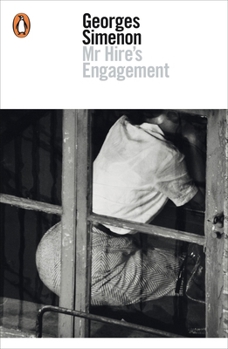
Mr Hire's Engagement


Select Format
Select Condition 
Book Overview
"A writer as comfortable with reality as with fiction, with passion as with reason." --John Le Carr
The basis for the 1947 French film noir classic Panique, which was rereleased in January 2017 Georges Simenon's chilling portrayal of tragic love, persecution and betrayal
"One sensed in him neither flesh nor bone, nothing but soft, flaccid matter, so much so that his movements were hard to make out. Very red lips stood out from his orb-like face, as did the thin moustache that he curled with an iron and looked as if it had been drawn on with India ink; on his cheekbones were the symmetrical pink dots of a doll's cheeks." People find Mr. Hire strange, disconcerting. The tenants in his building try to avoid him. He is a peeping Tom, a frequent client of sex workers, a dealer in unsavory literature. He is also the prime suspect for a brutal murder that he did not commit. But Mr. Hire's innocence will not stand in the way of those looking for a scapegoat as tragedy unfolds in this quietly devastating and deeply unnerving novel.
The basis for the 1947 French film noir classic Panique, which was rereleased in January 2017 Georges Simenon's chilling portrayal of tragic love, persecution and betrayal
"One sensed in him neither flesh nor bone, nothing but soft, flaccid matter, so much so that his movements were hard to make out. Very red lips stood out from his orb-like face, as did the thin moustache that he curled with an iron and looked as if it had been drawn on with India ink; on his cheekbones were the symmetrical pink dots of a doll's cheeks." People find Mr. Hire strange, disconcerting. The tenants in his building try to avoid him. He is a peeping Tom, a frequent client of sex workers, a dealer in unsavory literature. He is also the prime suspect for a brutal murder that he did not commit. But Mr. Hire's innocence will not stand in the way of those looking for a scapegoat as tragedy unfolds in this quietly devastating and deeply unnerving novel.
Format:Paperback
Language:English
ISBN:0141978465
ISBN13:9780141978468
Release Date:October 2015
Publisher:Penguin Books
Length:160 Pages
Weight:0.65 lbs.
Dimensions:0.4" x 5.0" x 7.6"
Age Range:18 years and up
Grade Range:Grade 12 and higher
Customer Reviews
4 ratings
Simenonic genius
Published by Thriftbooks.com User , 18 years ago
Georges Simeon was the ultimate spy. He perched on the edge of everyone's lives and wrote down in novel form exactly what he saw. The characters in his novels are more real than the characters in real life. All of the action takes place in a field that can only be described as the color gray-the rain cloud field in which our human tragedies and redemptions occur. I don't know why in lists of great writers of the twentieth century Simenon is not listed - up there with the likes of Kafka, Joyce, Proust, Lovecraft, Chesterton, Djuna Barnes, and all of the other players. Simenon was born for the twentieth century - it finds its most major representation in no other writer.
"Even from Mr. Hire's room, the goose bumps on her skin were visible."
Published by Thriftbooks.com User , 18 years ago
No question that for Simenon, less is more, as this enormously talented writer in "The Engagement" sketches out the essential lines of his protagonists and their rather drab and robotic lives with such skill that he engages us at every turn. What's real to Simenon is desire, greed, and death. There's little room here for sentiment, and if you're looking for a sweet confection, you've definitely entered the wrong door. Simenon has created a "modern" twentieth-century man, Mr. Hire, who really has no spiritual or moral center. He simply is a collection of habits and fears, spiced with perverse self-flagellating pleasures and one great but rather ridiculous skill. His alienation from society, which itself is presented as crude and hard and bordering on a violent mob, is sad and almost understandable, considering his dysfunctionality may have a basis in the gross nature of those who surround him. Yet his one soft spot is the highly sexual dairy maid, Alice, who lives directly across from him. Her little piece of paradise is so close that he can see right into her windows. So goes this Hitchcockian plot as Mr. Hire's robotic life is disrupted by this seductress and by the police. Underlying this plot is Simenon's writing machinery, which carries with it a valueless worldview. The author is really telling us we all amount to very little in the end: a collection of habits, enactments of our desires, and vain hopes for a better life. Why we are who we are is not of any significance to what we do while we are here in this life. I found this work to be extraordinary in its philosophical and psychological implications. Simenon was way ahead of his time as a writer and thinker. Not only that, his selection of detail and his ability to draw up whole scenes through the skillful use of the five senses could teach many a writer how to make the page come alive.
"You shall become engaged to a woman
Published by Thriftbooks.com User , 19 years ago
but another man shall lie with her." Deuteronomy 28:30 Georges Simenon was nothing if not prolific in both his literary and public life. Born in Belgium in 1903, Simenon turned out hundreds of novels. Simenon's obsession with writing caused him to break off an affair (he was prolific in this area of his life as well) with the celebrated Josephine Baker in Paris when he could only write twelve novels in the twelve month period in which they were involved. Although perhaps best known for his Inspector Maigret detective novels, Simenon also wrote over a hundred novels that he referred to as `romans durs' (literally "hard novels"). These hard stories typically involve a person's descent from normality (or a life that seems to bear the appearance of normality) into nihilism and despair. Usually there is a triggering event, a murder, a bankruptcy, or simply too much to drink on a road trip. The publishing arm of `"The New York Review" NYRB Books is reissuing Simenon's hard novels. "The Engagement" is one of Simenon's earliest hard novels and it was hard to put down. The story line is rather a simple one. Mr. Hire is a quiet man. But he isn't quiet in the way that he blends into the background. He's quiet in the way that his neighbors find him odd and more than a bit scary. Odd in such a way that children are pulled into their parent's apartment when he is heard walking around in his Paris apartment. And, critically for "The Engagement", odd in such a way that when a neighborhood prostitute is found murdered, the concierge in his apartment tells the police Hire is the culprit. "The Engagement" is a study in contrasts. It gives us Mr. Hire, going about his daily business and gives us the police (with the helpful assistance of Hire's neighbors) going about their business and slowly obtaining enough information to arrest him for murder. The storyline may not sound unique but the devil is always in the details. Simenon's prose may be direct and to the point but he manages to paint a compelling picture of his protagonists. Mr. Hire, the concierge, and the young girl across the street with whom Mr. Hire shares a voyeuristic relationship that holds the key to the story line, are all wonderfully drawn. Hire is not an attractive person yet this reader could not help but feel no small amount of empathy toward. It is hard to give examples without divulging too much of the plot. Suffice it to say that Simenon knows how to craft sentences that keep the reader turning page after page after page. Simenon's hard novels are often referred to as psychological novels but I find that term a bit misleading. Simenon does not analyze. He does not delve deep into his protagonists' minds. He presents a story stripped of moralizing or analysis. He presents the reader with a slice of the human condition, usually an unpleasant slice, and lets the reader deal with the implications, the psychoanalysis if you like. They do offer glimpses into his protagonists' liv
NYRB brings out another of simenon's great psychological novels
Published by Thriftbooks.com User , 19 years ago
Originally published in 1933, this slim volume already showcases Simenon's unique brand of realism, which eschews easy humanism in favor of a punishingly bleak moral universe. The story centers on Mr. Hire, the middle-aged son of working class immigrant parents. When a prostitute is murdered in his neighborhood, Hire's asocial habits, petty criminal record and ethically dubious profession leads the police to his door. Fed by the suspicions of vindictive neighbors, detectives tail him relentlessly, waiting for Hire to slip up and yield any evidence linking him to the crime. Readers of Simenon's so called 'romans durs' will find The Engagement to be an excellent early example of its type. Furthermore, the brief afterword by John Gray provides informative context for the novel as well as evidence of a rare instance of autobiographical sourcing.
Copyright © 2026 Thriftbooks.com
Terms of Use | Privacy Policy | Do Not Sell/Share My Personal Information | Cookie Policy | Cookie Preferences | Accessibility Statement
ThriftBooks ® and the ThriftBooks ® logo are registered trademarks of Thrift Books Global, LLC
ThriftBooks ® and the ThriftBooks ® logo are registered trademarks of Thrift Books Global, LLC
