


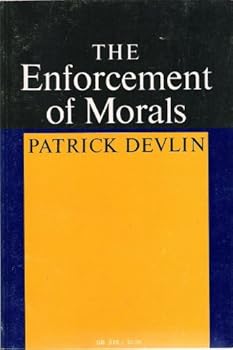
The Enforcement of Morals

Select Format
Select Condition 
Book Overview
In this provocative volume, Devlin offers fascinating discussions on topics ranging from the relationship of religion, morality, and the law; and the limits of the freedom of the individual within society; to the boundaries of the public and private in the realm of morals, and the point at which the law may enter.
Format:Paperback
Language:English
ISBN:0192850180
ISBN13:9780192850188
Release Date:October 1970
Publisher:Oxford University Press
Length:156 Pages
Weight:0.30 lbs.
Dimensions:7.7" x 0.4" x 5.1"
Related Subjects
Education & Reference Language Arts Law Linguistics Philosophy Words, Language & GrammarCustomer Reviews
1 rating
What makes a society is a community of ideas
Published by Thriftbooks.com User , 19 years ago
Lord Patrick Devlin lived from 1905 to 1992. He was a British judge from 1948 to 1960 and a defender of James Stephen's in his book "Liberty, Equality, Fraternity." Devlin makes a staunch argument for a shared morality in society in his book "The Enforcement of Morals." "There is disintegration when no common morality is observed and history shows that the loosening of moral bonds is often the first stage of disintegration, so that society is justified in taking steps to preserve its moral code as it does to preserve its government and other essential institutions. Actually, Devlin is willing to press even further than James Stephen is, in his support of the government's right in establishing and enforcing morality laws. "There are no theoretical limits to the power of the State to legislate against treason and sedition, and likewise I think there can be no theoretical limits to legislation against immorality." Lord Devlin wrote that an overwhelming majority of citizens in his country still found certain acts as morally repugnant and expected the government to use the force of law to punish people who committed such acts. The courts upheld this precept in Devlin's time. They ruled that government was responsible for not only the safety of the public, but also its moral well-being. Thus, one sees that the courts in Great Britain soundly rejected Mill's "liberty principle" with this ruling. Devlin made several good arguments for why the state had good reason to legislate morality for its citizens. First, the survival of society depends on the idea "that society may legislate to preserve itself." This idea meant that the state, through its elected representatives, had the obligation to legislate and uphold standards of morality. Devlin so astutely writes that, "What makes a society is a community of ideas, not political ideas alone, but also ideas about the way its members should behave and govern their lives." Second, Devlin observed that an elected legislator when enacting new laws would be upholding the accepted moral values that were already a part of the fabric of society. When legislators stray too far from upholding their society's morals and values, they more times than not, find themselves voted out of office. Devlin drew attention to the fact that many members of the elite class, especially those who were well educated, did not support his argument because they thought that they were better equipped than the average citizen, to reason what was morally correct for society. Although history has shown that democracies are not perfect and have perpetrated many egregious acts in the past, the elites, "do not dispute that in the end the will of the people must prevail nor do they seek to appeal from it to the throne of reason." Finally, Devlin so keenly observes that, "After all, Mill's doctrine has existed for over a century and no one has ever attempted to put it into practice." Stephen was more interested i
Copyright © 2026 Thriftbooks.com Terms of Use
| Privacy Policy | Do Not
Sell/Share My Personal Information | Cookie Policy | Cookie Preferences | Accessibility Statement
ThriftBooks® and the ThriftBooks® logo are registered trademarks of Thrift Books Global, LLC
ThriftBooks® and the ThriftBooks® logo are registered trademarks of Thrift Books Global, LLC
