


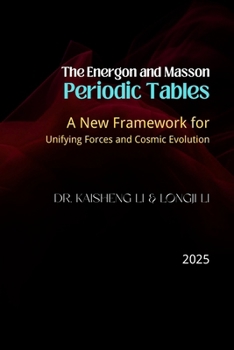
The Energon and Masson Periodic Tables: A New Framework for Unifying Forces and Cosmic Evolution
No Customer Reviews

The universe's evolution began with high-energy particle collisions in the fleeting moments after the Big Bang. Quarks, electrons, and photons collided randomly in a hot, dense environment, gradually forming stable structures through strong, weak, electromagnetic, and gravitational interactions: from quarks to hadrons, atoms to molecules, and eventually molecular clouds, stars, and galaxies. This hierarchical aggregation is not accidental but a manifestation of the {energy minimization principle}. Energy minimization is a universal trend in physical systems-seen in molecular bonding releasing energy in chemical reactions or gravitational collapse forming stars by releasing potential energy-and is a common feature of all fundamental interactions. This theory posits that forces are not independent entities but dynamic manifestations of energon exchange and energy redistribution. Whether it's the microscopic electromagnetic force (via photon exchange) or macroscopic gravity (potentially via graviton exchange), the essence is a dynamic process where systems transition to lower energy states through particle interactions. The core innovation of energon theory lies in classifying particles by frequency. Energons (bosons) are defined by their frequency (E = hf), encompassing photons, gluons, W/Z bosons, and hypothetical gravitons or dark photons. Massons (fermions) are defined by their equivalent frequency derived from rest mass (f = mc 2/h), covering quarks and leptons. This classification simplifies the complexity of the Standard Model and establishes a correspondence between mass and energy through the Planck formula (E = hf) and the mass-energy equivalence (E = mc 2). Crucially, the theory proposes that gravity arises from an energon density gradient (\nabla \rho), driven by low-frequency graviton exchange, which facilitates matter aggregation. This mechanism unifies with high-frequency energon exchanges (e.g., electromagnetic force) to form a cohesive physical picture. The density gradient not only reproduces Newton's law of gravity but also provides a novel microscopic interpretation of quantum gravity. The Revolutionary Significance of the Periodic Table
Mendeleev's periodic table revealed the intrinsic order of elements through atomic weight and chemical properties, predicting new elements like gallium and germanium, revolutionizing chemistry. Similarly, the \textbf{energon and masson periodic table} aims to uncover deep patterns in particle physics through frequency and equivalent frequency. The energon periodic table uses frequency (10 {-33} Hz to 10 {26}Hz) as the horizontal axis and interaction type as the vertical axis, incorporating known bosons (e.g., photons, gluons) and hypothetical particles (e.g., gravitons, dark photons). The masson periodic table uses equivalent frequency as the horizontal axis and fermion type or generation as the vertical axis, covering quarks, leptons, and potential fourth-generation particles. This periodic table not only organizes Standard Model particles but also predicts new particles, such as dark photons or supersymmetric fermions, through "gaps," providing clear directions for high-energy physics experiments.
Mendeleev's periodic table revealed the intrinsic order of elements through atomic weight and chemical properties, predicting new elements like gallium and germanium, revolutionizing chemistry. Similarly, the \textbf{energon and masson periodic table} aims to uncover deep patterns in particle physics through frequency and equivalent frequency. The energon periodic table uses frequency (10 {-33} Hz to 10 {26}Hz) as the horizontal axis and interaction type as the vertical axis, incorporating known bosons (e.g., photons, gluons) and hypothetical particles (e.g., gravitons, dark photons). The masson periodic table uses equivalent frequency as the horizontal axis and fermion type or generation as the vertical axis, covering quarks, leptons, and potential fourth-generation particles. This periodic table not only organizes Standard Model particles but also predicts new particles, such as dark photons or supersymmetric fermions, through "gaps," providing clear directions for high-energy physics experiments.
Format:Paperback
Language:English
ISBN:B0FRGM3F73
ISBN13:9798265842480
Release Date:September 2025
Publisher:Independently Published
Length:152 Pages
Weight:0.47 lbs.
Dimensions:0.3" x 6.0" x 9.0"
Customer Reviews
0 rating
Copyright © 2026 Thriftbooks.com
Terms of Use | Privacy Policy | Do Not Sell/Share My Personal Information | Cookie Policy | Cookie Preferences | Accessibility Statement
ThriftBooks ® and the ThriftBooks ® logo are registered trademarks of Thrift Books Global, LLC
ThriftBooks ® and the ThriftBooks ® logo are registered trademarks of Thrift Books Global, LLC
