
Skip to content
Scan a barcode
Scan
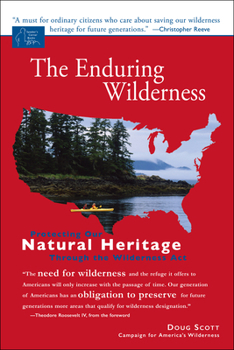
Paperback The Enduring Wilderness: Protecting Our Natural Heritage Through the Wilderness Act Book

ISBN: 1555915272

ISBN13: 9781555915278

The Enduring Wilderness: Protecting Our Natural Heritage Through the Wilderness Act

Select Format

Select Condition ThriftBooks Help Icon

Recommended

Format: Paperback

Condition: Very Good

$6.69
Save $8.26!
List Price $14.95
Only 7 Left
Save to List

Book Overview

A look at protecting America's wilderness and an explanation of the Wilderness Act.

In the fifty years under the Wilderness Act, Congress has enacted laws protecting more than 112 million acres of land in the United States.

Wilderness laws have been the good woks of deep-dyed conservative Republicans and Teddy Roosevelt progressive Republicans, of "Blue Dog" Democrats and liberal Democrats, and of Independents.

According to former senators Dale Bumpers and Dan Evans, "protecting wilderness areas is ... the most 'small-d' democratic land allocation process we've invented. Potential wilderness areas are identified by on-the-ground agency staff and local people who know the land best."

We have transformed so much of nature that it is increasingly important to save a decent sampling of the original American earth, without succumbing to our own short-term manipulative ambitions.

Customer Reviews

5 ratings

Where Man Himself Is a Visitor

This is an essential primer for all those wishing to learn more about the legislative and legalistic aspects of conservation activism. Doug Scott analyzes the history and politics behind statutory wilderness protection at the federal level, which culminated in the momentous Wilderness Act of 1964. I am proud to be from the same state (Pennsylvania) as two of the leading lights behind that legislation – Howard Zahniser and Rep. John P. Saylor. Believe it or not, Saylor was a Republican congressman, indicating that conservation has not always been the stark divisive issue that it is today. In the first half of this book, Scott gives a history of wilderness activism in the United States, from colonial times through the great influential figures of John Muir and Aldo Leopold, and how scattershot protection of valuable areas led to the need for the structured Act of Congress in 1964. The second half of the book, starting with Chapter 5, gets more interesting as Scott turns to the modern politics of conservation that have been embodied by citizen requests for protection of their valued wild areas. We learn that every president has approved additions to America's protected wilderness, even GWB, and that this has always been accomplished through bipartisan compromise. As proven in poll after poll, the majority of Americans, from all walks of life and political stances, favor the protection of wilderness. This knowledge is a valuable side effect of this book, in that Scott shows us that the American government has always had a strong sense of compromise and pragmatism, which has proven to be more effective than the divisiveness and narrow ideological posturing that you might think have swamped government processes, thanks to loudmouthed pundits and sound bite media coverage. I have met Doug Scott at a speaking engagement, and I feel that anyone who loves wilderness as an American tradition should become familiar with his works. [~doomsdayer520~]

Good, short overview of wilderness policy and politics

This book combines a brief history of American wilderness policy and politics with an impassioned plea for more wildernesses. Scott is the policy director for the Campaign for America's Wilderness, and a past recipient of the John Muir Award, so we are in no doubt where his sympathies lie. Scott has written an admirable little book. It is short (154 pages of text, with wide margins and lots of sidebar quotes taking up space), so you shouldn't expect an in-depth history of wilderness policy. However, he packs a lot of information in that space. He provides a brief overview of attitudes toward wilderness from Teddy Roosevelt through Aldo Leopold and others in the 1920s and 1930s. After this, his story takes us through the Wilderness Act of 1964 and then into current debates over wilderness. The centerpiece of his story is the question of statutory protection. Establishing a wilderness in the US requires an act of Congress and can be undone only by a similar act of Congress. This differs from other imaginable procedures, such as presidential decree or management agency discretion. Scott shows us why wilderness advocates came to believe that statutory protection was better than agency discretion, even if the agency was broadly sympathetic. He also argues that wilderness advocates were initially wrong in hoping for agency-based decisions subject only to congressional veto. Taking sole initiative away from agencies provided an incentive for grassroots citizen movements, which he believes has served the cause of wilderness well. As you can see from my preceding paragraph, Scott gives us enough information so that we can disagree with him - - an admirable trait in any piece of advocacy. A mountain biker could read this book to understand why Scott's vision of wilderness excludes bicycles, and could also find common ground with Scott on preserving natural areas. This mountain biker would also gain insight into political strategies for protecting bike trails effectively. Wilderness areas can be found in land managed by the National Park Service, the US Forest Service, Bureau of Land Management, and the Fish and Wildlife Service. Though he doesn't make a big deal out of the differences across agencies - - after all, he has to work with these people - - it's clear that some agencies are easier to work with than others. He makes a friendly plea for the NPS to rethink how it approaches wilderness, for example. Seeing the past century of wilderness policy also raises questions about our current dilemmas. Teddy Roosevelt, a Republican, was our greatest conservationist president. Important legislation passed under Nixon and Ford. The younger Bush, in contrast, is extraordinarily hostile to wilderness. Bush has the support of most of the western states in which wilderness lies, though individual counties voted for Kerry (Teton County, Wyoming; Glacier County, Montana; and most of the ski areas in Colorado). Wilderness advocates need to make

A great book for those interested in wilderness

I bought this book for a college class on wilderness and it provides a great overview of wilderness protection in the 20th century. It is amazing how so many years of history have been succinctly put into such a short book along with many insightful quotes. It is a great book for anyone interested in learning about protecting the wilderness.

A great book on an important and uniquely American topic.

In this book, Doug Scott provides us with an in-depth, refreshing and much needed look at the American Wilderness. We are all familiar with the wilderness of lore, whether it the pristine forests of Thoreau or the hostile wastes of the biblical prophet John. While these are powerful images they can't really compare to the diverse and very tangible wildernesses which are outlined in this book. Mr. Scott does a wonderful job both in detailing the ideas of the American Wilderness and the history and policy which brought this idea into reality. I was fortunate enough to have used this book as a text for a college course. It is by far the most interesting college text book I have! Mr. Scott presents a compelling look at the American Wilderness while at the same time giving us a hopeful outlook for its future. If you plan to have an opinion, you'd better read this first!

The Enduring Wilderness a must read!

An essential historical narrative of our National Wilderness Preservation System. Scott uses the very words of those individuals who played key roles in the passage of the 1964 Act and his own experience and expertise in the field to tell the compelling tale of a truly American ideal: Wilderness. I couldn't put it down!
Copyright © 2026 Thriftbooks.com Terms of Use | Privacy Policy | Do Not Sell/Share My Personal Information | Cookie Policy | Cookie Preferences | Accessibility Statement
ThriftBooks ® and the ThriftBooks ® logo are registered trademarks of Thrift Books Global, LLC

GoDaddy Verified and Secured