


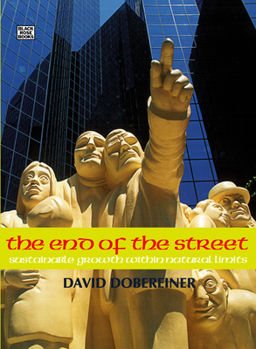
End of the Street

Knowing that global land uses require radical rethinking, David Dobereiner looks at how development ideals can be translated into practical techniques that conserve natural resources, take advantage... This description may be from another edition of this product.
Format:Paperback
Language:English
ISBN:1551642786
ISBN13:9781551642789
Release Date:May 2006
Publisher:Black Rose Books
Length:239 Pages
Weight:0.80 lbs.
Dimensions:0.7" x 6.8" x 9.0"
Customer Reviews
3 ratings
An architect's Take on the Climate Crisis
Published by Thriftbooks.com User , 19 years ago
The End of The Street: Sustainable Growth Within Natural Limits was written by my partner so I am prejudiced. but nevertheless, it is an important book. I had the opportunity to watch David work on the book for many years and can vouch that he has been ahead of his time in many areas, especially ecology. One of his co-workers once said that he could solve a design problem better and faster than any other architect he knew and I have witnessed this many times over . In " The End of the Street", he presents many examples of ecological and architectural ideas, in word and in image. His views of the sustainable city and of the society of the future are brilliant and innovative. David is a dedicated, earnest, quietly intelligent, creative person with a great deal to donate to the discussion of the climate crisis, to architecture and to our world. David became a vegetarian over 55 years years ago when, as an architectural student in England, he was sent to study slaughter houses. His love of animals is evident in the book. The description of our cat is particularly apt. David rides his bike almost everywhere and tries to live as ecologically as possible so, he does not recommend things that he doesnt try to practise in his daily life. I'm not sure if the American public is yet ready to forgo the large single family house and the 3 cars and the huge stores but with the climate crisis becoming more imminent,there may be no choice. David has adapted Matripolis so that other countries with varying topographies and populations, especially poor countries, might find an answer for their housing and ecological problems. Apart from general reading I hope that The End of the Street will be used as a text ...It is informative, interesting ,timely and well written.
Design can save the planet
Published by Thriftbooks.com User , 19 years ago
David Dobereiner's just published THE END OF THE STREET, Sustainable Growth Within Natural Limits, gives us hope that our march toward oblivion can be reversed through examples of "green" communities both large and small. Dobereiner gives examples; his model city Matripolis, his rammed earth buildings in Nepal and his Tenerife Bioclimatic Design house in the Canary Islands. I recommend this book for design students almost as enthusiastically as I once did R. Buckminster Fuller's OPERATING MANUAL FOR SPACESHIP EARTH, and Victor Papanek's DESIGN FOR THE REAL WORLD. THE END OF THE STREET will provoke discussion and convince young people to design responsibly to save the planet. Al Gowan Professor Emeritus of Design Massachusetts College of Art, Boston
Landmark for Environmental Designers
Published by Thriftbooks.com User , 19 years ago
...I found Dobereiner's book the most staggeringly impressive, on its subject, that I have ever come across. The contents of the book bring so much insight and information, emerging from his creative genius that I believe it is epoch making, a landmark for all environmental designers as well as an inspiration for the life-positive evolution of homo sapiens. Paul Ritter Author of 'Planning for Man and Motor'
Copyright © 2026 Thriftbooks.com
Terms of Use | Privacy Policy | Do Not Sell/Share My Personal Information | Cookie Policy | Cookie Preferences | Accessibility Statement
ThriftBooks ® and the ThriftBooks ® logo are registered trademarks of Thrift Books Global, LLC
ThriftBooks ® and the ThriftBooks ® logo are registered trademarks of Thrift Books Global, LLC
