


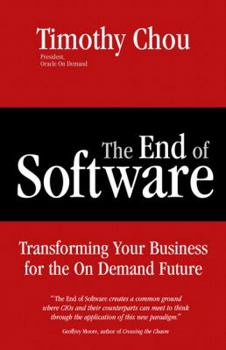
The End of Software: Finding Security, Flexibility, and Profit in the on Demand Future


Do you know what is the real cost of your software? Before you reach for a calculator, be forewarned that it's a trick question. Even technology industry analysts and seasoned IT executives have... This description may be from another edition of this product.
Format:Paperback
Language:English
ISBN:0672326981
ISBN13:9780672326981
Release Date:July 2004
Publisher:Sams Publishing
Length:170 Pages
Weight:0.60 lbs.
Dimensions:0.5" x 6.0" x 9.0"
Customer Reviews
3 ratings
Very informative
Published by Thriftbooks.com User , 18 years ago
The End of Software is a well written book about the opportunities and challenges of Software as a Service (SaaS). Not only does it go over key concepts, but it illuminates these with apt examples. Software as a Service has tremendous potential and this book explains why. The book focuses definitely more on the benefits of SaaS and does not cover some of the challenges that SaaS has, e.g. usability, service integration and others. HTML is very good for several scenarios, but it does fall short in some areas and simply should not be used. But today with Flash/Flex and Silverlight there are solutions that address several of these short comings in the usability area. Similarly, integration products make it easier to integrate SaaS solutions with on-premises software, so the barriers for getting more SaaS solutions to the market are getting less and less. For anyone getting a good grounding on SaaS I can definitely recommend this book.
IT Outsourcing, the Oracle Model
Published by Thriftbooks.com User , 22 years ago
Although titled The End of Software, the book really doesn't mean that. It's about outsourcing the IT function along the lines of EDS, IBM's Global Services, or Oracle On Demand. As president of Oracle On Demand, most of the busines stories concern successful contracts where Oracle On Demand has set up or replaced the IT department in a number of companies. What the title means is that the end user does not buy the software, he buys the service provided by that software. There's still an awful lot of software involved. There are clear advantages to this kind of outsourcing. The big outsourcing companies have exonomies of scale, they can buy dozens or thousands of computers, all just alike. This minimizes the maintenance effort, they can upgrade the software on all units cheaper than a company can do it on a few machines. It improves reliability, they can use this machine if that one is broken. They can fully understand the laws, such as the privacy laws relating to human resources information. And they have many other advantages. Unfortunately this does come with some disadvantages as well. For one thing, they use standardized software packages, if your application fits, that's great, otherwise, well.... Then you have to be of the right size. Too small and they're not interested. Too large and you probably have your own legacy systems that switching off may lose you a lot of historical information. This is an interesting book, well worth reading if you are in the IT department of a middle sized business. It clearly explains the advantages of the outsourcing business model.
On Demand Software with some Oracle perspective
Published by Thriftbooks.com User , 22 years ago
While there are strong arguments in favor of the software on demand model of usage and Dr. Chou makes most of them, he also sometimes descends into a rambling state. There is some repetition and some irrelevancies; my estimate is that ten percent of the material could have been left out. Dr. Chou is the president of Oracle on Demand, so of course he has a vested interest in praising the software on demand model. Nevertheless, he does a reasonably good job of keeping his prose from reaching the level of evangelisms. The software on demand model is one where the user essentially rents the software on an on-demand basis. When needed, the latest version is either downloaded or run directly on a server. The primary advantage is one of remaining current. The present situation regarding regular security patches is only marginally viable. Nearly all system managers live in fear of failures whenever a new service pack or patch is installed. The recent situation with the latest Microsoft XP service pack is a case in point. When a vendor has to include a list of all the applications that will fail after the service pack is installed and how to get them functional again, then there is a major problem. If the software runs on the vendor's server, then this problem is alleviated. This will also prevent the current problems with unpatched systems. IT people are generally swamped and the fear of crashes after installing a patch is one of the primary reasons why patches are not applied. Many of the recent systemic viral/worm attacks occurred well after a patch that could prevent it was available. Of course, there are problems with the distributed computing model. It will require that all vendors have bulletproof servers and connections. It would only take a small amount of downtime or a major security breach to convince many customers that they prefer to have the software on their machines. Also, the current model forces application developers to create significant upgrades. For if they don't, users will continue to use the older versions and the revenue stream will dry up. Therefore, if an oligarchy or monopoly were to develop, innovation could suffer. Finally, since the models for on demand software are not yet clearly delineated, no one knows how providers will interact with their customers. Many people have doubts about how this will work, and the recording industry has recently engaged in some disturbing legal actions. These actions could be unique to the recording industry or a precursor to how the on demand world would function. While Chou does mention some of these problems, they are not delved into in great detail, which is a weakness of the book. If you are someone whose portfolio includes the planning of organizational software usage, then you should read this book. The strengths outnumber the weaknesses, so if you read it keeping the perspective of the author in mind, then you will learn the most significant aspects of a new way of "consuming"
Copyright © 2026 Thriftbooks.com
Terms of Use | Privacy Policy | Do Not Sell/Share My Personal Information | Cookie Notice | Cookie Preferences | Accessibility Statement
ThriftBooks ® and the ThriftBooks ® logo are registered trademarks of Thrift Books Global, LLC
ThriftBooks ® and the ThriftBooks ® logo are registered trademarks of Thrift Books Global, LLC
