


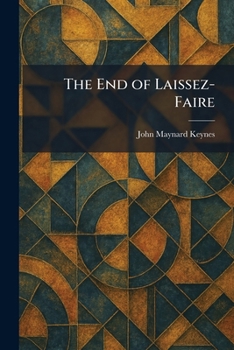
The End of Laissez-Faire

"The End of Laissez-Faire" is a seminal essay by the influential economist John Maynard Keynes that explores the evolution and eventual decline of the principle of individualism in economic policy. Keynes traces the history of the doctrine, examining how the concept of a self-regulating market became the dominant orthodoxy and why, by the early 20th century, it had become inadequate to meet the complexities of modern society.
In this provocative work, Keynes argues that the "natural" harmony of interests assumed by classical economists does not always exist. He calls for a more nuanced approach to the role of the state, suggesting that government intervention is necessary where private initiative fails to achieve social stability or efficiency. By critiquing the rigid adherence to non-interference, Keynes lays the intellectual groundwork for managed capitalism and the development of modern macroeconomics.
Essential for students of political science, philosophy, and economics, "The End of Laissez-Faire" remains a powerful critique of dogmatic economic theory. It offers a clear-eyed analysis of the boundaries between the individual and the state, providing a foundational text for understanding the transition from Victorian economic thought to the interventions of the twentieth century.
This work has been selected by scholars as being culturally important, and is part of the knowledge base of civilization as we know it. This work was reproduced from the original artifact, and remains as true to the original work as possible. Therefore, you may see the original copyright references, library stamps (as most of these works have been housed in our most important libraries around the world), and other notations in the work.
This work is in the public domain in the United States of America, and possibly other nations. Within the United States, you may freely copy and distribute this work, as no entity (individual or corporate) has a copyright on the body of the work.
As a reproduction of a historical artifact, this work may contain missing or blurred pages, poor pictures, errant marks, etc. Scholars believe, and we concur, that this work is important enough to be preserved, reproduced, and made generally available to the public. We appreciate your support of the preservation process, and thank you for being an important part of keeping this knowledge alive and relevant.
Customer Reviews
ThriftBooks ® and the ThriftBooks ® logo are registered trademarks of Thrift Books Global, LLC
