


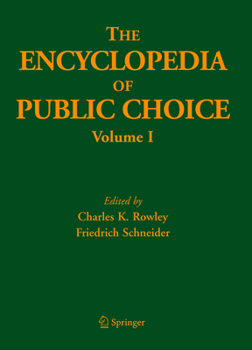
The Encyclopedia of Public Choice
No Customer Reviews

Select Format
Select Condition 
Book Overview
The Encyclopedia provides a detailed and comprehensive account of the subject known as public choice. However, the title would not convey suf- ciently the breadth of the Encyclopedia's contents which can be summarized better as the fruitful interchange of economics, political science and moral philosophy on the basis of an image of man as a purposive and responsible actor who pursues his own objectives as efficiently as possible. This fruitful interchange between the fields outlined above existed during the late eighteenth century during the brief period of the Scottish Enlightenment when such great scholars as David Hume, Adam Ferguson and Adam Smith contributed to all these fields, and more. However, as intell- tual specialization gradually replaced broad-based scholarship from the m- nineteenth century onwards, it became increasingly rare to find a scholar making major contributions to more than one. Once Alfred Marshall defined economics in neoclassical terms, as a n- row positive discipline, the link between economics, political science and moral philosophy was all but severed and economists redefined their role into that of 'the humble dentist' providing technical economic information as inputs to improve the performance of impartial, benevolent and omniscient governments in their attempts to promote the public interest. This indeed was the dominant view within an economics profession that had become besotted by the economics of John Maynard Keynes and Paul Samuelson immediately following the end of the Second World War.
Format:Paperback
Language:English
ISBN:1475780044
ISBN13:9781475780048
Release Date:July 2013
Publisher:Springer
Length:1105 Pages
Related Subjects
Business Business & Investing Economics Political Science Politics & Social SciencesCustomer Reviews
0 rating
Copyright © 2026 Thriftbooks.com Terms of Use
| Privacy Policy | Do Not
Sell/Share My Personal Information | Cookie Policy | Cookie Preferences | Accessibility Statement
ThriftBooks® and the ThriftBooks® logo are registered trademarks of Thrift Books Global, LLC
ThriftBooks® and the ThriftBooks® logo are registered trademarks of Thrift Books Global, LLC
