


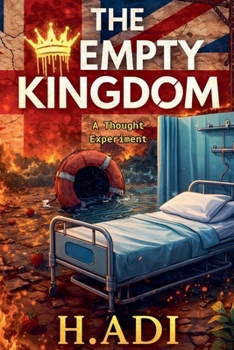
The Empty Kingdom

The Empty Kingdom
A Thought Experiment
By H. Adi
In today's Britain, immigration is more than a topic-it's the engine behind headlines, the spark for political debates, and the lens through which crime, the economy, and national identity are scrutinized. The conversation stretches from Parliament's grand halls to viral social media threads, and even the hum of evening living rooms-often with a certainty that owes more to soundbites than substance.
Behind the arguments are real people-communities who feel unheard, families who feel left behind, and others who came to build a life yet find themselves blamed for problems they did not create. Between frustration, fear, and misunderstanding, the human reality is often lost in the noise.
But what would happen if immigrants vanished overnight?
No warning.
No explanation.
Just... gone.
At first, the country barely notices.
But then hospitals begin to struggle. Construction sites fall silent. Food rots in fields. Transport slows. Care homes lose staff. Universities empty. Businesses come to a halt. The systems people rarely think about-but rely on every day start to fall apart.
In The Empty Kingdom, H. Adi explores a bold thought experiment: a Britain where every immigrant suddenly vanishes. Through facts, humour, and sharp observation, the book follows the domino effect unfolding across the nation's economy, public services, and everyday life.
This is not a lecture.
It is not a political manifesto.
Instead, it asks a simple but powerful question:
Do we truly understand how modern Britain works-and who keeps it running?
Drawing on lived experience, research, and a healthy dose of British irony, H. Adi invites readers to consider an alternate reality where the absence of millions of immigrants forces the country to confront something it rarely acknowledges.
Because sometimes, the only way to understand a system...
is to imagine what happens when everyone holding it together disappears.
Thought-provoking, surprising, and occasionally uncomfortable, The Empty Kingdom challenges readers to rethink one of the most heated debates of our time.
Customer Reviews
ThriftBooks ® and the ThriftBooks ® logo are registered trademarks of Thrift Books Global, LLC
