


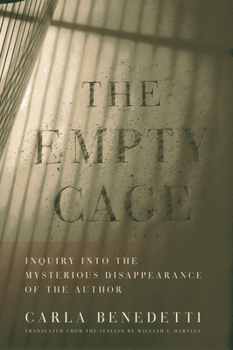
The Empty Cage: Inquiry Into the Mysterious Disappearance of the Author

Select Format
Select Condition 
Book Overview
"Authorialism is like a chronic and progressive disease of modernity. It leads art to the impasse of a totally reflected and 'rationalized' practice. The author as project-maker assumed to be at the origin of the work has now replaced the genius; the author as strategist squanders every margin of nonreflective activity conceded to artistic practice; the writer, reduced to an eye that observes itself, is caught in the cage of her own self-observation."--from Chapter 1In The Empty Cage, the highly regarded Italian literary critic Carla Benedetti explores the question: What is an author? Expanding Foucault's arguments beyond literary discourse into art, film, performance, and industrial design, Benedetti maintains that the author carries out a historical function, integrally connected to the modern system of artistic production and of esthetic evaluation. In the modern period, she says, any object can be considered a work of art, on the supposition that it has been produced by an author. Her book, far from being an attempt to reclaim authorial intention as essential, proposes an original theory that shows how the author, in the form of author-images and even logos, has become an important link in the modern system of artistic communication. Discussing authors who include Borges, John Cage, Calvino, Duchamp, Proust, and Cindy Sherman, Benedetti addresses the principal aesthetic problems of modernity, showing how late modernity approached and refashioned them. She suggests that the author has become metaphorically a diagnostic expression of all of modernity's maladies, that part of a sick organism into which all symptoms of the illness converge. Thus she sees the author's death (and with it postmodernity as a whole) as a great "work of mourning" produced by a tired Western modernity; a mourning for what it no longer believes to be possible: that is, to grow and to generate.
Customer Reviews
ThriftBooks® and the ThriftBooks® logo are registered trademarks of Thrift Books Global, LLC
