


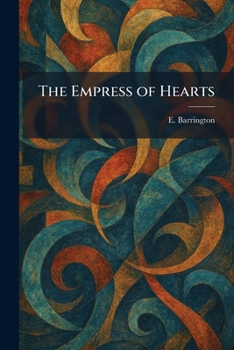
The Empress of Hearts

"The Empress of Hearts" is a compelling historical novel that breathes life into the tragic and opulent world of Marie Antoinette. Set against the backdrop of the pre-Revolutionary French court, the narrative follows the beautiful and misunderstood Queen of France as she navigates the treacherous waters of Versailles. Central to the story is the infamous Affair of the Diamond Necklace, a scandal involving deception, forgery, and misplaced trust that irrevocably damaged the reputation of the monarchy.
E. Barrington masterfully weaves historical fact with rich imaginative detail, portraying Marie Antoinette not merely as a symbol of excess, but as a woman of deep feeling caught in the gears of history. Through vivid descriptions and intricate characterizations, the book explores themes of power, courtly intrigue, and the human cost of political instability. This evocative work offers readers a front-row seat to the elegance and underlying tension of the 18th-century French aristocracy, capturing the essence of a pivotal era that would soon be swept away by the tides of revolution.
This work has been selected by scholars as being culturally important, and is part of the knowledge base of civilization as we know it. This work was reproduced from the original artifact, and remains as true to the original work as possible. Therefore, you may see the original copyright references, library stamps (as most of these works have been housed in our most important libraries around the world), and other notations in the work.
This work is in the public domain in the United States of America, and possibly other nations. Within the United States, you may freely copy and distribute this work, as no entity (individual or corporate) has a copyright on the body of the work.
As a reproduction of a historical artifact, this work may contain missing or blurred pages, poor pictures, errant marks, etc. Scholars believe, and we concur, that this work is important enough to be preserved, reproduced, and made generally available to the public. We appreciate your support of the preservation process, and thank you for being an important part of keeping this knowledge alive and relevant.
Customer Reviews
ThriftBooks ® and the ThriftBooks ® logo are registered trademarks of Thrift Books Global, LLC
