


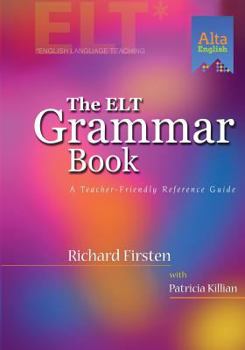
ELT Grammar Book: A Teacher-Friendly Reference Guide

Select Format
Select Condition 
Book Overview
At long last English language teachers have what they've been waiting for, a "professional friend" to give a helping hand at all times! A great deal more than a grammar book, this new resource... This description may be from another edition of this product.
Format:Paperback
Language:English
ISBN:1882483901
ISBN13:9781882483907
Release Date:October 2017
Publisher:Alta English Publishers
Length:586 Pages
Weight:2.22 lbs.
Dimensions:1.2" x 7.0" x 10.0"
Customer Reviews
4 ratings
Best for Native Speakers
Published by Thriftbooks.com User , 19 years ago
I just finished a class on English Structure using this as our textbook. The authors bring you through reasoning about grammar principles/rules/nuances via examples and short exercises. I found it to be an extremely useful review of basic to advanced grammar points, with helpful hints on activities and common gotchas for ESL/EFL students. I give this 5 stars for the native english speaking teacher (However, I would give 4 stars as a resource for teachers who have english as a second language themselves, as much of the book's exercises assume you inductively learned many of the rules, and I could see this being lost on the non native speaker. However, they do explain the subtle nuances in most cases, so it is still a good guide).
A definite MUST for all language teachers
Published by Thriftbooks.com User , 19 years ago
This book should not only be used by ESL/ESOL/VESOL teachers, but by anyone who teaches grammar. Every detail is explained, the exercises and are easy to follow. Teachers will never use another book once they see how complex material is made easy to explain.
THE ELT GRAMMAR BOOK: A TEACHER-FRIENDLY REFERENCE GUIDE
Published by Thriftbooks.com User , 22 years ago
The ELT Grammar Book is a reference guide forteachers of English to speakers of other languages.Readers may recognize the author's name as thecolumnist of "Grammatically Speaking" in TESOLMatters and "The Grammar Guy" in ESL Magazine.Richard Firsten has taken his grammatical expertiseand produced a reference tool that focuses on topicsboth difficult to understand and explain. The style iscasual and relaxed, which is a pleasant deviationfrom typical pedantic grammar reference materials.Though extensive and in-depth (22 chaptersand 8 appendices totaling over 550 pages), the text isnot intended to be exhaustive. Topics were restrictedto include only high frequency areas typically mosttroublesome to teachers and L2 learners alike.Eighteen of the chapters focus on grammar-exclusivethemes that include such topics as adjectives, articles,modal auxiliaries, passives, prepositions,subjunctives, verb tenses, and word order. Threechapters are primarily discourse related.Autosegmentals are analyzed in chapters 15 and 18;the former chapter covers word and phrase stresswhile the latter focuses on sentence-level intonation.Chapter 21 is entitled "ELT 'Waifs'" and deals withrelaxed pronunciation, intensifiers, and commonphrases seldom included in instructional texts.Phrases that add so much to the flow of conversationalEnglish such as "a great deal of" or the frequent useof the suffix "-ish" (childish, pinkish, late-ish, aroundeight-ish) can assist the L2 student in understandingcommon discourse. In the final chapter, the authornotes the changing nature of the English languageand predicts upcoming transformations that are likelyto occur.Each of the 21 instructional chaptersconcludes with "Teaching Tips," which supplyinstructors with resources that allow students toflesh out the content material through numerousactivities designed for pairwork and/or small groups.These activities alone make the text a valuableresource. Scattered throughout many of the chaptersis an aside called "Troubleshooter." Thisinformational box interrupts instructional sectionswith pertinent explanations in anticipation ofstudents' questions. Another strength of the text isthe salient feature of the inductive method ofinstruction. For example, situations are oftenpresented in the form of dialogs so that readers canobserve the grammar point contextually. Byhighlighting selected portions of the dialog andthrough provocative questioning, the writer modelsa lesson requiring the reader to elicit a rule or tofigure out why a certain construction is used.Employing this critical thinking strategy leads todiscovery, and ideally, to student ownership of thatspecific grammar point. At a minimum, adding thismethod to one's teaching repertoire will supplydiversity to classroom instruction.Finally, the eight appendices cover a rangeof subject matter that includes strategies, games,pronunciation, spelling, and further elaboration onpreviously covered material. For instance, the authorhas provided an exce
Fall in Love with Grammar
Published by Thriftbooks.com User , 22 years ago
First of all, do not be put off by the title. This is not a traditional, dry grammar book, filled with every rule of correct English usage. Those of you who know Richard Firsten's publications, such as "Troublesome English" and the "Real Life Grammar" series, will not be surprised that "The ELT Grammar Book" is really a teacher's guide to the most common, and most difficult to explain, points of English grammar. The book devotes a chapter to 20 of the most common areas of grammatical difficulty, such as word order, articles, subjunctives, and direct object companions. Each area is dealt with in the following three ways: The Socratic Approach - whereby readers are encouraged to observe, think about, and make conclusions about the point. This technique enables exploration of the grammar in a way which is much more meaningful in the long run. Instead of committing rules to memory without really understanding why they exist, this method helps you understand the point so that you can more easily explain it to your students. "Troubleshooters" - These are helpful insights that occur in most chapters, which focus on the points which are likely to cause problems for students because of language interference or other reasons. "Teaching Tips" - These are activities, exercises, and games designed to help teachers make the teaching of grammar more enjoyable. Towards the end of the book there are a couple of interesting chapters which you would not expect to find in a grammar book. The first of these deals with "ELT Waifs," words or phrases or phenomena which occur in casual language usage, but are not usually explained or codified, such as the use of words like "over," "that," and "quite." Even more surprising is the final chapter, which attempts to predict how we might expect English grammar to develop in the future based on its past development. I may not happen to agree with some of the predictions, but their inclusion displays the Mr. Firsten's obvious interest in the life of languages. In addition to the chapters, there are very useful appendices that explain points in more depth and even cover helpful rules for spelling and pronunciation. Although I have been teaching English for over 15 years, I discovered a new way of understanding complex grammatical points in nearly every chapter, and more importantly, I found ways of explaining these points in simple terms without having to resort to academic language. If, like me, you dread being asked why English grammar adheres to its own peculiarities, and have been searching for simple explanations, you will love this book.
Copyright © 2026 Thriftbooks.com Terms of Use
| Privacy Policy | Do Not
Sell/Share My Personal Information | Cookie Policy | Cookie Preferences | Accessibility Statement
ThriftBooks® and the ThriftBooks® logo are registered trademarks of Thrift Books Global, LLC
ThriftBooks® and the ThriftBooks® logo are registered trademarks of Thrift Books Global, LLC
