


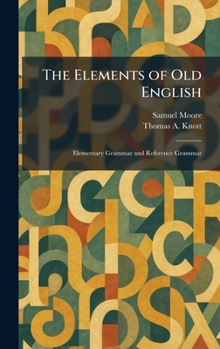
The Elements of Old English: Elementary Grammar and Reference Grammar

"The Elements of Old English: Elementary Grammar and Reference Grammar" by Samuel Moore and Thomas A. Knott serves as an essential foundation for students and scholars of the Anglo-Saxon language. This authoritative work is meticulously designed to provide both a clear introduction for beginners and a robust reference for those engaged in advanced philological study. The text covers the fundamental aspects of Old English, including its complex phonology, inflectional morphology, and syntax, ensuring a well-rounded understanding of the language's structure.
The volume is structured to facilitate ease of learning, moving from basic grammatical principles to more detailed discussions of dialects and linguistic evolution. By focusing on the core elements of the language, Moore and Knott enable readers to engage directly with the primary texts of the period, from heroic poetry to historical prose. As a staple in the field of Germanic linguistics, this grammar remains a vital resource for anyone seeking to master the linguistic roots of the English language and to explore the rich literary heritage of early medieval England.
This work has been selected by scholars as being culturally important, and is part of the knowledge base of civilization as we know it. This work was reproduced from the original artifact, and remains as true to the original work as possible. Therefore, you may see the original copyright references, library stamps (as most of these works have been housed in our most important libraries around the world), and other notations in the work.
This work is in the public domain in the United States of America, and possibly other nations. Within the United States, you may freely copy and distribute this work, as no entity (individual or corporate) has a copyright on the body of the work.
As a reproduction of a historical artifact, this work may contain missing or blurred pages, poor pictures, errant marks, etc. Scholars believe, and we concur, that this work is important enough to be preserved, reproduced, and made generally available to the public. We appreciate your support of the preservation process, and thank you for being an important part of keeping this knowledge alive and relevant.
Customer Reviews
ThriftBooks® and the ThriftBooks® logo are registered trademarks of Thrift Books Global, LLC
