


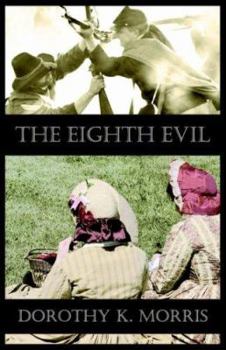
The Eighth Evil

No Synopsis Available.
Format:Paperback
Language:English
ISBN:1589398998
ISBN13:9781589398993
Release Date:July 2006
Publisher:Virtualbookworm.com Publishing
Length:404 Pages
Weight:1.13 lbs.
Dimensions:0.9" x 5.5" x 8.5"
Customer Reviews
4 ratings
God throws love down like a gauntlet to the Mockingbird Hill menagerie
Published by Thriftbooks.com User , 19 years ago
"The Eighth Evil" is the third book in the Mockingbird Hill saga of Dorothy K. Morris, which began in "Secret Sins of the Mothers," set mostly during the Civil War on a Low-Country plantation in South Carolina. When the war ended Charlie O'Donnell and Anthony Parish, a pair of war weary Confederate soldiers, made their way back home. But while Anthony returned to the Mockingbird Hill plantation, Charlie decided to go on to Texas, as detailed in "Coyotes of Creek Crossing." Now Charlie is making his way back home in the company of two Yankee ladies, to find out what happened to his daughter Margaret Grenville, her child, and the ex-slaves who have refused to leave Mockingbird Hill. As if the blight of Reconstruction was not enough, the Perry sisters, devout Yankee haters, have fled from Charleston to try and play ladies of the manor at the war-ravaged plantation. Morris adds even more ingredients in a recipe for disaster to set up a series of object lessons for her cast of characters in her continuing saga of reconciliation. I rounded up on "The Eighth Evil" for three reasons. The first is that this is best book to date in the Mockingbird Hill series (I trust it will be more than a trilogy) and I wanted to indicate that as much in my rating in a system that denies us the ability to add a half star (I know, it is a slippery slope to wanting quarter stars and worse, but I stand at the precipice wanting to jump). Each book in the series has been better that the previous ones as she makes her way up the publishing ladder. The second is that when an author comes up with a title like "The Eighth Evil" they are going all in and they had better come up with something that readers can accept as an appropriate addition to a list that has been around since the early days of the Christian Church. The good news is that when we get a couple hundred pages into the book and Charlie tells Margaret about a meeting at which a different sort of preacher talked about the seven deadly sins, Morris does indeed come up with something I am perfectly willing to accept as justifying the title. It even works out for Morris in that the Seven Holy Virtues that correspond to the Seven Deadly Sins do not include the obvious one that would be the counterpart to Morris' title. The final reason I wanted to give "The Eighth Evil" a bit of a boost is that Morris comes up with a really nice payoff scene to one of the major conflicts in the novel. We are all well aware that have a secret that can destroy a relationship is a major source of dramatic conflict in romance stories, and when Margaret Grenville and Anthony Parish finally come to the big moment of confrontation I really liked how Morris lets it play out. Her choice might not be totally originally, but a similar example does not leap to my mind and regardless the scene came across as a fresh breeze. Almost as important, it made by like Anthony Parish as much as I did Charlie O'Donnell, and that is saying someth
A Great Read!
Published by Thriftbooks.com User , 19 years ago
I have been following Dorothy's career with great interest and have read her 2 previous books. Once I started The Eighth Evil, I found it hard to put it down except to go to work. I consider her characters to be old friends. She takes them to the next chapter in their lives in this book. She has such an easy way to 'hook' the reader and seamlessly spins in philosphies on life that are timeless. I look forward to 'hearing' more from her.
An emotionally rich, evocative work of historical fiction
Published by Thriftbooks.com User , 19 years ago
It only takes a few sentences to figure out that Dorothy K. Morris is a natural born storyteller. The Eighth Evil is just a wonderful work of historical fiction, taking the reader back to the traumatic days of a proud Southern people suffering the indignities of defeat following the War for Southern Independence. You have the exhausted soldier making his way back to a home that no longer exists, a young woman enduring a personal grief that goes far beyond that of the normal vicissitudes of war, two proud Charlestonian sisters seemingly incapable of adapting to a world where Yankees patrol the streets of their beloved city, a family of children left destitute by the war, a noble assortment of former slaves, and an assortment of various other immeasurably rich and vivid characters (including a couple of displaced Yankee women). It's a lot of people to keep up with, but Morris makes it easy with her vivid characterization of each and every one of them. This is, above all else, a story about people, a diverse group of displaced individuals learning - and sometimes failing to learn - how to come together, put aside varying degrees of hatred, pride, and guilt, and reforge a new life for themselves in the ashes of a culture irrevocably changed forever. Anthony Parish returns home from the war to find his beloved Tally's Hook plantation burned to the ground and many of his friends and family deceased or departed. He does find one friendly face at nearby Mockingbird Hill, that of Margaret, a sweet girl who has grown into a mature, beautiful woman. Now a young widow, she resides there with her infant son and three loyal ex-slaves. She gladly teams up with Anthony to try and get the plantation running again, but trouble soon blows in with the two Perry sisters from a devastated Charleston. Totally incapable of adapting to a life of poverty, they force Margaret and her son out of the house and mistreat the former slaves who still regard the place as home. Their pride goeth before a fall, however, and the very real threat of starvation eventually brings Anthony and Margaret back to Mockingbird Hill. Soon the unconventional family is joined by Margaret's father (who arrives with a Yankee mother and daughter at his side) and the orphaned Hardway children. Even as he tries to get two plantations back on their feet again, Anthony never shirks the responsibility of caring for his fellow men - even if one of them doesn't deserve it. With that one exception, all of these characters really do become a family, and emotional highs and lows define their new way of life. This story sucked my emotions all the way in, as Morris' storytelling prowess makes you a living witness to the outrages, tragedies, and celebrations that coincide with a people clawing themselves back from the brink of ruin to start an altogether new kind of life in a much-changed South Carolina Low Country. The emotions Morris puts into this story are palpable indeed. Since most South
A Spellbinding Read
Published by Thriftbooks.com User , 19 years ago
Not having the luxury of previously reading the first two installments in Dorothy K. Morris' Mockingbird Hill Series ('Secret Sins of the Mothers' 1999 and 'Coyotes of Creek Crossing' 2004), this reader jumped into the historical fiction of life after the Civil War without preconceived opinions. After reading THE EIGHTH EVIL, drinking in all the atmosphere and intrigue contained in this very fine recreation of North Carolina in the years following the defeat of the South, the natural urge is to turn to the initial books for more background and more pleasure! Morris is a no nonsense writer: she is committed to storytelling and has the facility to unravel a huge cast of characters without ever once losing the reader's interest. Mockingbird Hill is a plantation left standing in 1865 and it serves as the meeting ground of disparate family members, pretenders, freed slaves, perpetrators, wily deceivers, opportunists AND some very interesting characters with complex and fascinating pasts. The story progresses at such a fine pace that the ingredients defy summary. It is a tale of broken lives, pride, the problems that were inherent in emancipation, and the even greater problems reassembling family in the aftermath of a war that desecrated the country. Morris wisely allows just the right amount of philosophy to spin through her characters' lives, and in the end we are left with an inspiring attitude about the power of love in shouldering and overcoming seemingly monumental egos. The characters Morris paints are indelible in her writing skills - so much so that learning more about the history of Mockingbird Hill from her earlier books becomes a hunger. While this may not qualify as a great American novel, it certainly is a compelling read and one that literally dares the reader to put it down before finishing it. Grady Harp, August 06
Copyright © 2026 Thriftbooks.com Terms of Use
| Privacy Policy | Do Not
Sell/Share My Personal Information | Cookie Policy | Cookie Preferences | Accessibility Statement
ThriftBooks® and the ThriftBooks® logo are registered trademarks of Thrift Books Global, LLC
ThriftBooks® and the ThriftBooks® logo are registered trademarks of Thrift Books Global, LLC
