


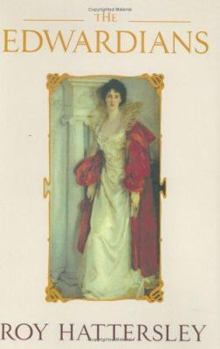
The Edwardians


Select Format
Select Condition 
Book Overview
Edwardian Britain has often been described as a golden sunlit afternoon---personified by its genial and self-indulgent King. In fact, modern Britain was born during the reign of Edward VII, when politics, science, literature, and the arts were turned upside down. In Parliament, the peers were crushed for the first time since Magna Carta. Irish nationalists and suffragettes took politics out on to the streets. Home Rule and Votes for Women were delayed, not precipitated, by the First World War. Great parliamentary stars such as Lloyd George and Winston Churchill typified an era in which personalities dominated the headlines of the new tabloid newspapers. It was the age of Rolls and Royce, Scott and Shackleton, Edward Elgar, Shaw, the Pankhursts, and Mrs. Alice Keppel, whose social life was reported without mention of her relationship with the King. The theater of ideas superseded drawing room dramas. Novelists of genius---from Henry James to D. H. Lawrence---produced a masterpiece each year. A London gallery caused a sensation with an exhibition of "Postimpressionists." Edward Elgar was the first English composer for two hundred years to stand comparison with the continental European masters. In sport, Victorian chivalry was replaced with unashamed professionalism. Man flew for the first time and the motorcar became a common sight on city streets. Physicists examined the structure of the atom and philosophers disputed the traditional definition of virtue. The churches tried, without success, to confront and confound a new skepticism. Explorers sought to prove that men could live, and die, like gods. Drawing on previously unpublished diaries and letters, Roy Hattersley's The Edwardians is a beguiling account of a turbulent and frequently misunderstood period. It is a full and often humorous portrait of an era that he elevates to its rightful place in British history.
Format:Hardcover
Language:English
ISBN:0312340125
ISBN13:9780312340124
Release Date:June 2005
Publisher:St. Martin's Press
Length:528 Pages
Weight:1.85 lbs.
Dimensions:9.5" x 1.5" x 6.4"
Customer Reviews
3 ratings
A very STIFF upper lip!
Published by Thriftbooks.com User , 17 years ago
This book was definitely not what I expected! I didn't realize that it was going to be so drily political. Having said that, after plodding through it, I have to admit it did explain a great deal of the whys & wherefores of the edwardian era. This is definitely NOT a light read!
A Good Read, Save For The Literature
Published by Thriftbooks.com User , 18 years ago
Rot Hattersley is a politician. He has been a prominent member of the Labour party for some time, as MP, deputy leader, and cabinet minister. He still sits in the House of Lords. What does one get when a lifelong politician pens a book about an era? It should come as no surprise that the politics of the era predominates. For those interested in the labyrinthine machinations between the various MPs and PMs and whatnot during the time, Hattersley's book lacks for nothing. I was particularly impressed with his account of the Finance Bill and how it forced a coalition government at the time, with Irish Home Rulers reaping the benefit. But for those who haven't stood (One doesn't run in England.) for a seat in the House of Commons or have not devoted their lives to the history of parliamentary politics, the first couple hundred pages may make for a bit of a snooze. But the book is otherwise very well done indeed. Hattersley's account of the suffragettes will shock any Yank notions of English ladies gleaned from watching Masterpiece Theatre too often. Also - and this development could constitute a book in itself - his account of the rise of professionalism in sports is spot on. Brits and Yanks both in this early 21st Century, late Elizabethan era need to be reminded that it wasn't so long ago that anyone who played sports for a living was looked down upon as hopelessly déclassé rather than idolised. My primary grouse with this work is that Hattersley makes a dog's breakfast of things when it comes to literature. Yes, he gives Yeats his fair accolade. How could he not? But not only, as another reviewer has already adduced, does Hattersley postdate the publication of Middlemarch by a score of years, but he seems not to even have read The Ambassadors by Henry James. I agree that it is James's best novel, but apparently Hattersley read an entirely different version than the rest of us: Strether does not leave America for England, but for France (Paris to be more precise). And he does not find there - Perish the thought! - that "pragmatism becomes more important than principle." He discovers that aesthetic pleasure becomes more important than principle. Also, Hattersley's assertion that James was a closet homosexual is hotly disputed. In Edel's definitive biography, he comes out as more asexual than anything, possibly due to a mishap when he was a child. But, aside from this muddle he makes of literature, Hattersley has done a bang-up job of covering the Edwardians. Nice apropos pictures here as well.
Engaging!
Published by Thriftbooks.com User , 20 years ago
I was excited to see a brand new book devoted to the Edwardian era since the interest in the era seems to have died out in the 1970s. Though wordy at times, Hattersley brings to life the glamour and the harsh reality that existed side by side in a time that has been swept away by the World Wars. Hattersley's book is an excellent, and at times more detailed introduction into the era known as Edwardian--though books published in the 1970s and before have the benefit of being authored by contemporaries of the time and/or contemporaries of that time were still living.
Copyright © 2026 Thriftbooks.com
Terms of Use | Privacy Policy | Do Not Sell/Share My Personal Information | Cookie Notice | Cookie Preferences | Accessibility Statement
ThriftBooks ® and the ThriftBooks ® logo are registered trademarks of Thrift Books Global, LLC
ThriftBooks ® and the ThriftBooks ® logo are registered trademarks of Thrift Books Global, LLC
